There are a number of reasons why I decided to take on this project. My first reason has to do with my interest in birds. This began shortly after moving to Victoria ten and a half years ago. With our house backing onto a wooded area, the chirping of birds is a familiar sound all year long. I often glance out the window to see birds of all forms in the yard throughout the day. Frequently I will pull out the Birds of Victoria or Birds of North America reference guides we have on hand. Unfortunately, the drawings in the first aren’t overly helpful for identification and the number of entries in the second is overwhelming. My second reason has to do with a photography course I took a number of years ago. Since that time I have been trying to think of a practical reason to buy a new camera. Taking pictures of birds requires a powerful zoom lens which my previous point-and-shoot camera could not accommodate. Perfect! My final reason was my desire to take on a new project to welcome in 2011. Hence, bird of the day was born.


Tuesday, May 31, 2011

Spotted Sandpiper

Actitis macularia

Appearance:
Medium-small shorebird
Pale eyebrow and dark eyeline
White wedge up onto shoulder
Breeding plumage:
  • Orange bill with black tip
  • Brown head, back and upperwings with small black bars
  • White underparts with round, dark spots
Non-breeding plumage: (pictured below)
  • Dark bill with pale base
  • Pale brown head, back and upperwings with dark and buff bars
  • White underparts, without dark spots
Listen to its call.

I may be dating myself but for some reason this bird made me think of the classic line from the old children's reader Fun with Dick and Jane -- "See Spot. See Spot run".  It had a distinct and constant teetering motion when it walked. "Funny, funny Spot".


Learn more about the Spotted Sandpiper.

Additional pictures:
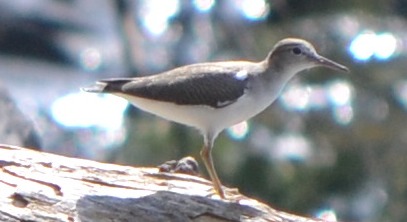
non-breeding
 

Sunday, May 29, 2011

California Quail

Callipepla californica

Appearance:
Plump, ground-dwelling bird
Short tail
Round wings
Small head
Curved, forward-tilting topknot

Male:
  • Black face with white border
  • Dark brown cap
  • Pale buff forehead
  • Blackish nape stippled with white spotting
  • Dark blue-gray chest
  • Brown back and upperwings
  • Buff belly with darker scaly markings and chestnut center
  • Brown flanks with white streaks
Female: (not photographed)
  • Grayish-brown head, chest, back and upperwings 
  • Chestnut flanks with white streaks
  • Pale belly with darker scaly markings

Listen to its call.
 

As we were driving down Charlton Road today on our way to Hastings Flats, two of these birds crossed in front of our car before ducking under a decorative hedge.


I love the head plumes on these birds - they looks so regal - but did you know that what actually looks like a single feather is really a group of six feathers? Just another little bit of trivia for you.


Learn more about the California Quail.

Monday, May 23, 2011

American Pipit

Anthus rubescens

Appearance:
  • Medium-sized songbird
  • Slender bill
  • White eye ring and eye brow
  • Gray-brown upperparts with fine black streaks on back 
  • Blackish wings with buff edges
  • Buff underparts with dark streaks on breast and flanks
  • White throat with dark streak on cheek
  • Black tail with white outer tail feathers
  • Black legs and feet

Listen to its call.


I initially thought these were small shorebirds when I saw them walking along the bank at Panama Flats. Their size and behaviour were similiar to the Western and Least Sandpipers I had seen in the same area the previous week. However, as I got closer, I noticed that they looked more sparrow-like but without the conical bill.  They also had a habit of bobbing their tails up and down as they pecked at the ground, while at the same time running along in a haphazard manner.  Sort of like patting your head and rubbing your belly at the same time!

Learn more about the American Pipit.

Sunday, May 22, 2011

Cliff Swallow

Petrocheidon pyrrhonota

Appearance:
Chestnut face and throat
Whitish forehead
Dark cap, back and tail
Buff-coloured rump and nape
White belly and chest
Short, square-tipped tail
Tiny bill

Listen to its call.

I saw this bird hanging out with a flock of barn swallows at Panama Flats yesterday. There don't seem to be any cliffs in the area but there's definitely a lot of mud around for these birds to use for building nests. Apparently, they gather mud from the flood plains and carry it back to their nests in their bills.

Learn more about the Cliff Swallow.

Saturday, May 21, 2011

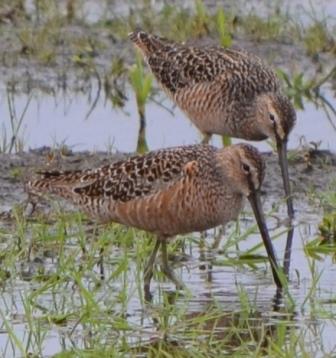
Long-billed Dowitcher

Limnodromus scolopaceus

 
Appearance:
  • Medium-sized shorebird
  • Long, straight bill
  • Long, greenish legs
  • Short neck
  • Dark crown and eyeline
  • Black bars on tail feathers wider than white
  • Breeding plumage:
  •      Mottled brown upperparts
  •      Rich chestnut underparts
  •      Barred sides
  • All gray in winter

Listen to its call.

 
What better way to spend a cloudy Saturday morning than probing in the mud with half a dozen friends? Okay, so that might not appeal to everyone but these birds seemed to be having a great time bobbing their heads up and down in the shallow waters of Panama Flats.

Learn more about the Long-billed Dowitcher.

Friday, May 20, 2011

Turkey Vulture

Cathartes aura
 
Appearance:
Very large bird
Small, unfeathered, red head
Hooked, ivory-colored bill
Brownish-black plumage
Long wings with gray flight feathers underneath
Long, rounded tail
Pink legs and feet

Listen to its call.

Leaving Island View beach this afternoon, I noticed two of these birds roosting in a dead tree by the side of the road. I was surprised at their rather comical appearance; the head is extremely small in relation to the body. After watching them for several minutes they took off over the fields. A little while later I caught sight of them soaring overhead without seeming to flap their wings at all.  They just seemed to float on the air currents. It was quite beautiful to watch. I have trouble relating these birds to the dirty, unscrupulous scavengers that their reputation affords them.


Learn more about the Turkey Vulture.

Wednesday, May 18, 2011

Blacked-headed Grosbeak

Pheucticus melanocephalus

Appearance:
Medium-sized, stocky songbird
Large, cone-shaped bill.

Male:
  • Deep orange breast, collar and underparts
  • Black head and upperparts
  • Black and white wings 
  • White undertail coverts
  • White spots in black tail
Female: (not photographed)
  • Black and white crown stripes
  • Buffy underparts with streaking at the sides
  • Dark gray upperparts
Listen to its call.

I heard this bird long before I saw it perched at the top of a tree near Blenkinsop Lake last evening. The weather was ideal for a stroll after dinner and the vocal performance given by this bird was enjoyed by many along the boardwalk.

Learn more about the Black-headed Grosbeak.

Additional pictures:
Juvenile