There are a number of reasons why I decided to take on this project. My first reason has to do with my interest in birds. This began shortly after moving to Victoria ten and a half years ago. With our house backing onto a wooded area, the chirping of birds is a familiar sound all year long. I often glance out the window to see birds of all forms in the yard throughout the day. Frequently I will pull out the Birds of Victoria or Birds of North America reference guides we have on hand. Unfortunately, the drawings in the first aren’t overly helpful for identification and the number of entries in the second is overwhelming. My second reason has to do with a photography course I took a number of years ago. Since that time I have been trying to think of a practical reason to buy a new camera. Taking pictures of birds requires a powerful zoom lens which my previous point-and-shoot camera could not accommodate. Perfect! My final reason was my desire to take on a new project to welcome in 2011. Hence, bird of the day was born.


Showing posts with label shorebird. Show all posts

Tuesday, September 18, 2018

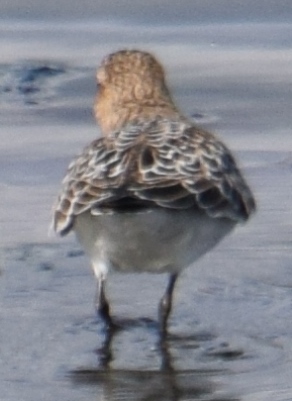
Baird's Sandpiper

Calidris bairdii

Appearance:
Small to medium shorebird
Black legs
Slightly drooping, black bill
Long wings extending beyond the tail
Dark brown, scaly upperparts
White underparts
Dark centre of rump and tail
Light brown head and breast, with dark streaking
Juvenile:
     Buff colored breast
     Scaly upperparts

 Learn more about the Baird's Sandpiper.


Tuesday, November 10, 2015

Red Knot

Calidris canutus

Appearance:
Medium-sized sandpiper
Grey plumage
Dark primaries
Long, straight bill
Short yellow/green legs
Breeding:
     Rufous-red head and breast
     Mottled gray and black upper parts
Immature:
     White-tipped wing feathers

Listen to its call.

This sandpiper has been reported by numerous birders in the last few weeks, both at Kitty Islet and on the beach at the end of Bowker Avenue in Oak Bay. It has been roosting on the rocks offshore with a large number of Dunlins and Black-bellied Plovers.


The Red Knot (on the right) is larger than the Dunlin (on left) but smaller than the Plover (in centre). It's straight bill is the same length as it's head. Although initially described as showing a reddish wash on its breast, this seems to have disappeared as it transitioned into its winter plumage.

Learn more about the Red Knot.

Wednesday, November 26, 2014

Marbled Godwit

Limosa fedoa

Appearance:
Large shorebird
Long, slightly upcurved bill; pink at base with dark tip
Evenly buff-brown
Dark barring
Long legs

Listen to its call.

This sandpiper was probing for food in the mud on this coastal beach. Okay, so the beach wasn't exactly in Victoria. (It was in San Diego). Although rare, sightings of these birds do occur in the Victoria area most years.

Learn more about the Marbled Godwit.

Friday, May 4, 2012

Black-necked Stilt

Himantopus mexicanus


Appearance:
Large /medium-sized shorebird
Black upperparts
White underparts
White spot above each eye
Red eyes
Long, black, needle-like bill
Long neck
Very long, thin red-pink legs

Listen to its call.

Having read reports of sightings of these birds at Maber Flats recently, I decided to venture out to Brentwood Bay in search of a new entry for my collection. With our trusty road map in hand, we followed the directions posted on the Victoria rare bird alert transcript. After driving around in circles for what seemed like forever, we discovered that our inability to find a road leading to the area was not due to our navigational skills afterall. The roads weren't there; they only existed on paper. Talk about misplaced trust. I thought those kinds of things only happened when you used a GPS.

Learn more about the Black-necked Stilt.

Thursday, October 20, 2011

Pectoral Sandpiper

Calidris melanotos

Appearance:
  • Medium-sized shorebird
  • Medium-sized, slightly drooping, dark bill
  • Yellowish legs
  • Black patch on rump extending onto tail
  • Thin, white wing stripe  
Adult:
  • Brown head with dark streaks
  • Pale supercilium
  • Black back feathers and wing coverts with brown edges
  • Brown breast with fine streaks ending abruptly and contrasting with white underparts
Juvenile:
  • Similar to adult
  • Back feathers and wing coverts with pale brown, rust, or golden edges
  • White 'V's on back
  • Dark rusty crown

Listen to its call.
 
And now for a couple of definitions. The supercilium is the eyebrow region.  Wing coverts are the feathers that cover the base of quill feathers.


I saw these two shorebirds at McIntyre Reservoir, in the Martindale area, a few days ago. Although this is private property, the land owner kindly allows birders access to view the reservoir from the dike surrounding it. I wasn't able to get too close to these birds but you can still get a clear picture of the sharp border between the dark breast and the white belly. The legs in these photos look quite dark but I think it is just the lighting, or quite possibly mud.  It's curious how their bellies remain so white. 

Learn more about the Pectoral Sandpiper.

Monday, August 29, 2011

Semipalmated Sandpiper

Calidris pusilla

Appearance:
Small sandpiper
Black legs
Short, blunted-tipped black bill
Pale, scaled grayish-brown upperparts 
White underparts
Fine streaks on breast and sides

Listen to its call.

I saw this bird amidst the other small peeps on the mudflats at Sidney Spit on the weekend. It was very similar in size and shape to the Lesser and Western Sandpipers, with only its straight, blunt bill to differentiate it from the others..... or so I thought. 
Check out the feet.

Semipalmated refers to the half-webbed toes


 Learn more about the Semipalmated Sandpiper.

Saturday, August 27, 2011

Semipalmated Plover

Charadrius semipalmatus


Appearance:
  • Small plover
  • Grey-brown above
  • White below
  • Single, dark chest band
  • Black breast band, sides of head, and forecrown in breeding adults; brown in non-breeding adults and juveniles.
  • Yellowish-orange legs
  • Short, dark bill with orange base  (all black on juvenile)
Listen to its call.

Having no obligations for the day, I suggested to my husband that we take the ferry to Sidney Spit for a picnic. It was a lovely day for it; sunny, but not too hot, and lots of shorebirds to photograph.  Perfect! 

A number of flocks of these birds were around the beach, foraging for food on the tidal flats. All of the ones I saw had black bills, making me wonder if perhaps I'd made a mistake with their identity. Then I caught sight of their feet, which reassured me. Semipalmated is an adjective used to describe wading birds that have toes webbed for part of their length. Oddly enough, I only discovered this when I looked up the word in the dictionary. Why don't the bird books tell you these things? 


 Learn more about the Semipalmated Plover.

Wednesday, August 24, 2011

Lesser Yellowlegs

Tringa flavipes


Appearance:
  • Medium sandpiper
  • Long, yellow legs
  • Long, straight, dark bill
  • Mottled brownish-black and white upperparts
  • White rump and underparts
  • Dark barring on tail, visible in flight  
Listen to its call.

Trying to distinguish between Lesser and Greater Yellowlegs has proven difficult for me.  I've been told that the bill is the key.  The length of the bill of the Lesser variety is about the size of its head width, while the bill of the Greater variety is noticeably longer.  However, because the angle of its head affects my perception, I still struggle to make this determination. The call, as usual, is also a key factor.  So, believe it or not, I actually paid attention to it this time.  The call of this bird was a short and fairly quiet tew-tew. Eureka!  I think I've finally found a Lesser Yellowlegs (or is it just wishful thinking on my part?).

Learn more about the Lesser Yellowlegs.

Tuesday, August 23, 2011

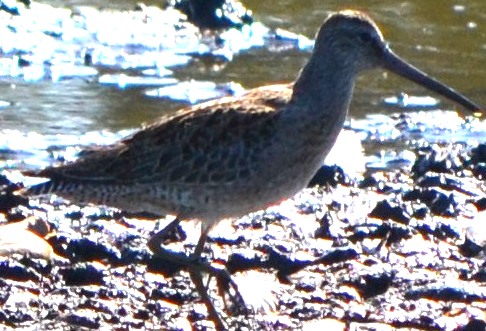
Short-billed Dowitcher

Limnodromus grieseus

Appearance:
  • Medium-sized shorebird
  • Long, straight bill
  • Long, greenish legs
  • Short neck
  • Dark crown and eyeline
  • White and black bars of equal width on tail feathers
  • Breeding plumage:
  •     Mottled brown upperparts
  •     Pale orange underparts
  •     Spotting on sides
  •     White belly
  • Overall grey in winter
Listen to its call.
White and black bars of equal width on tail feathers
By late summer, most of the water has dried up at Panama Flats. Only a few large puddles remain where shorebirds congregate ... when the gaggles of Canada Geese allow it. Seeing a number of different sized shorebirds towards the centre of the flats, I moved in for a closer look, attempting to make my way through the squishing mud without any creeping up my sandals. It was disgusting! The mucky, (and I'm sure) excrement-covered shoes are still sitting outside our front door, too foul to be allowed in the house. The things I do just to get a picture! 

Learn more about the Short-billed Dowitcher.

Sunday, July 31, 2011

Wandering Tattler

Heteroscelus incanum

Appearance:
Medium-sized sandpiper
Short, thick, yellow legs
Solid gray upperparts
Finely streaked face
Dark eye line
White eye ring
Longish, straight, black bill
Breeding:
   Heavily barred underparts
Non-breeding:
   Gray breast
   White belly

Listen to its call.

After enjoying a cup of tea at the Ogden Point Cafe this afternoon, I went for a short stroll along the breakwater. Being a long weekend, the area was bustling with activity: people on the walkway, divers in the water and shorebirds at the water's edge. I was taking pictures of a group of Black Turnstones on the rocks below when my husband drew my attention to this bird.  It was bobbing along the ledge on the outside of the breakwater, moving surprisingly quickly. If it hadn't stopped at regular intervals to probe for food, I would have had to take up jogging just to keep up with it. Thankfully, I didn't have to go to those extremes to get these pictures.


Learn more about the Wandering Tattler.

Tuesday, May 31, 2011

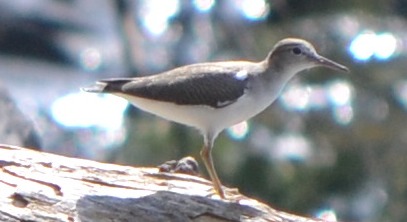
Spotted Sandpiper

Actitis macularia

Appearance:
Medium-small shorebird
Pale eyebrow and dark eyeline
White wedge up onto shoulder
Breeding plumage:
  • Orange bill with black tip
  • Brown head, back and upperwings with small black bars
  • White underparts with round, dark spots
Non-breeding plumage: (pictured below)
  • Dark bill with pale base
  • Pale brown head, back and upperwings with dark and buff bars
  • White underparts, without dark spots
Listen to its call.

I may be dating myself but for some reason this bird made me think of the classic line from the old children's reader Fun with Dick and Jane -- "See Spot. See Spot run".  It had a distinct and constant teetering motion when it walked. "Funny, funny Spot".


Learn more about the Spotted Sandpiper.

Additional pictures:
non-breeding
 

Saturday, May 21, 2011

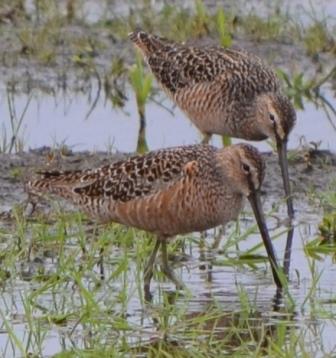
Long-billed Dowitcher

Limnodromus scolopaceus

 
Appearance:
  • Medium-sized shorebird
  • Long, straight bill
  • Long, greenish legs
  • Short neck
  • Dark crown and eyeline
  • Black bars on tail feathers wider than white
  • Breeding plumage:
  •      Mottled brown upperparts
  •      Rich chestnut underparts
  •      Barred sides
  • All gray in winter

Listen to its call.

 
What better way to spend a cloudy Saturday morning than probing in the mud with half a dozen friends? Okay, so that might not appeal to everyone but these birds seemed to be having a great time bobbing their heads up and down in the shallow waters of Panama Flats.

Learn more about the Long-billed Dowitcher.

Sunday, May 15, 2011

Sanderling

Calidris alba

Appearance:
Small sandpiper
Medium-length, straight, dark bill
Dark legs
White wingstripe bordered in black
Breeding plumage: (no photo)
Rufous head and neck
Rufous wash extending onto back
Non-breeding plumage:
Pale gray head and upperparts
White underparts
Faint, partial gray breast band

Listen to its call. 

I saw this bird running along the tide line at Esquimalt Lagoon beach with a couple of Dunlins last week. The three of them would run up the beach to avoid the waves, then turn and run back down as the waves receded. They were probably just looking for food but they reminded me of playful children enjoying a day at the shore.

Sanderling (left) / Dunlin (right)
Being a student of linguistics, the origin of words always interests me. So, what about Sanderling?  Although I really have no idea of its origin, I have a theory. Sandpiper has been truncated in the middle and the suffix -ling, which is a diminutive modifier, has been added to the noun. So, in essence, its name means that it's a small sandpiper. Isn't linguistics fun?!

Learn more about the Sanderling.

Additional photos:

Thursday, May 12, 2011

Whimbrel

Numenius phaeopus

Appearance:

  • Large shorebird
  • Long, decurved bill
  • Long, dark legs
  • Grayish-white and brown head stripes
  • Brown upperparts with small light and dark spots 
  • Brown streaked neck and breast
  • White belly and undertail coverts 

 Listen to its call.

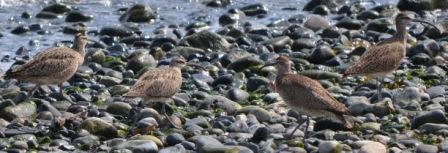
On a visit to Esquimalt Lagoon this afternoon, I was pleasantly surprised to find a number of interesting birds on the beach to the south. This group of six were using their long, curved bills to probe in the sand, probably in search of invertebrates for dinner.


Learn more about the Whimbrel.

Tuesday, May 10, 2011

Western Sandpiper

Calidris mauri


Appearance:
  • Small sandpiper
  • Moderately long bill, thinner at tip than at base, with slight droop
  • Black legs
  • White underparts
  • Thin, white wing stripe
  • Black line on rump extends onto tail


Adult:
  • Indistinct white supercilium
  • Rufous scapulars, crown and cheek (breeding plumage)
  • Black back feathers and wing coverts with white edges
  • Much black streaking and spotting on breast
  • Black chevrons on flanks
Juvenile:
  • Indistinct gray crown and pale supercilium
  • Rufous scapulars
  • Black-based back feathers and wing coverts with white and gray edges
  • Faint, partial gray breast band
Listen to its call.

Western Sandpipers (back) / Least Sandpiper (front)
This bird is very similar in appearance to yesterday's bird of the day. However, when seen together, the Western Sandpiper is slightly larger than the Least Sandpiper. The longer bill and dark legs also set these birds apart.
 
Learn more about the Western Sandpiper.

Monday, May 9, 2011

Least Sandpiper

Calidris minutilla

Appearance:
Small sandpiper
Short, dark bill, drooping at tip
Yellowish legs
Brown head
White underparts

Adult:
  • Whitish supercilium with darker crown and eyeline
  • Gray-brown to black back feathers and wing coverts with brown edges
  • Thin, white wing stripe
  • Brown breast with black spotting
  • Gray-brown breast band usually present
  • Black line on rump extending onto tail
Juvenile:
  • Pale supercilium with rusty crown
  • Black back feathers and wing coverts with bright rusty edges
  • White "V" on back
  • Breast with golden cast and fine streaking
Listen to its call.

Dozen of these birds were foraging at the upper edge of the mudflats when I visited Panama Flats last week. These birds may be the smallest shorebirds in the world, but what they lack in size they certainly make up for in number.   

Learn more about the Least Sandpiper.

Friday, May 6, 2011

Solitary Sandpiper

Tringa solitaria

Description:
  • Medium-sized, slender shorebird
  • Moderately long legs
  • Thin, straight bill
  • White eye-ring
  • Brown back with white spotting
  • Brown and white streaking on head, neck and sides
  • White belly
  • Black tail with barred edges

Listen to its call.

According to the Webster's New World College Dictionary, the word 'solitary' is from the Latin sōlitārius meaning alone or by itself.  Hmmm.... just as I thought! Why then did I see three of these birds together at Panama Flats yesterday afternoon?  Apparently they are not truly solitary. However, unlike other shore birds, they do not migrate in large flocks.

Learn more about the Solitary Sandpiper.

Monday, March 14, 2011

Black-bellied Plover

Pluvialis squatarola

Description:
Medium-sized shorebird
Short, thick black bill
Short neck
Dark legs
Dark wing tips
Winter adult:
    Gray head 
    White underparts
    Gray, mottled back
Breeding plumage:
    Black from face to belly 

Listen to its call. 

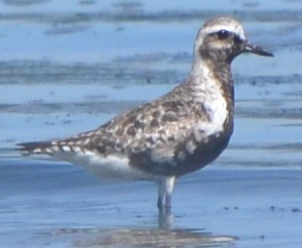
I saw a group of these birds on the rocks at Clover Point yesterday afternoon. They were bigger than the Dunlin feeding close by. The tide was low and they were having quite a feast until three Black Oystercatchers came along and frightened them all away.


No wonder I had difficulty identifying this bird.  There wasn't a black-belly to be seen.  However, in breeding plumage (pictured below), it is black from the face to the belly. 


Learn more about the Black-bellied Plover. 

Sunday, March 6, 2011

Surfbird

Aphriza virgata

Appearance:
Short, stocky shore bird
Dusty gray with white belly
Dark spots along side
White tail with black tip
Short, stout, dark bill, with orange on bottom
Yellow legs
Breeding plumage: Rusty on back, breast spotted

I was watching a group of Black Turnstone off Ten Mile Point yesterday when I noticed a couple of the birds had lighter plumage than the others. As I looked more closely, I saw the orange on their lower bills and realized I had found another new bird for my blog. I wonder how many times I have looked at them in the past, hidden in plain view.  I'll have to brush up on my observation skills.  Anyone have a Where's Waldo book I can borrow?


Learn more about the Surfbird.

Wednesday, February 9, 2011

Black Oystercatcher

Haematopus bachmani

Appearance:
Large shore bird
Black plumage
Long, heavy red bill
Yellow eyes
Red eye-ring
Long pink legs and feet

Listen to its call.

I had no trouble recognizing this fellow at Clover Point this afternoon. Its distinctive bill made identification easy. At low tide, two of these birds were foraging for molluscs in the intertidal zone. From what I could see, it looked like quite a spread. Driving home afterwards, I noticed two more by Oak Bay Marina. It came as no surprise, therefore, to read that these birds are usually seen in pairs.

Interesting fact for the day:  Despite its name, this bird's diet consists mainly of limpets and mussels. 

Learn more about the Black Oystercatcher.