There are a number of reasons why I decided to take on this project. My first reason has to do with my interest in birds. This began shortly after moving to Victoria ten and a half years ago. With our house backing onto a wooded area, the chirping of birds is a familiar sound all year long. I often glance out the window to see birds of all forms in the yard throughout the day. Frequently I will pull out the Birds of Victoria or Birds of North America reference guides we have on hand. Unfortunately, the drawings in the first aren’t overly helpful for identification and the number of entries in the second is overwhelming. My second reason has to do with a photography course I took a number of years ago. Since that time I have been trying to think of a practical reason to buy a new camera. Taking pictures of birds requires a powerful zoom lens which my previous point-and-shoot camera could not accommodate. Perfect! My final reason was my desire to take on a new project to welcome in 2011. Hence, bird of the day was born.


Showing posts with label small. Show all posts

Tuesday, August 2, 2016

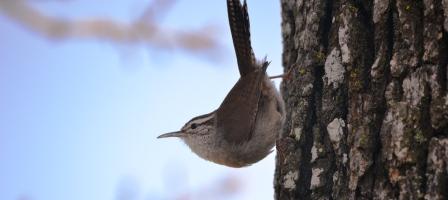
House Wren

Troglodytes aedon 

Appearance:
Small, compact bird
Fairly long, curved bill
Longish tail
Gray-brown upperparts
Dull, grayish-white underparts, including sides of head
Dark barring on wings and tail
Juvenile:
     Blackish mottling on breast

Listen to its call.

This is another hatch year bird that we banded last weekend.

Most wrens are small and brown with short wings and tails which they often hold upright. So, how do you tell them apart? Well, here are a few distinguishing features that help with wren identification.
  • House Wren -- curved bill, faint eyebrow, fairly long tail and dingy breast
  • Bewick's Wren -- straight bills, bold eyebrow and white breast
  • Pacific Wren -- almost no tail, bold eyebrow, smaller and darker than House Wren 

Learn more about the House Wren.

Tuesday, October 18, 2011

Golden-crowned Kinglet

Regulus satrapa

Appearance:
Tiny songbird
Short, notched tail
Thin, black bill
Olive-grey above
Greyish-white below
Two white wing-bars
Dark flight feathers with golden edging
Broad, white eyebrow
Black-striped crown
Yellow crown center (female)
Orange crown center (male)
Black legs
Yellow feet

Listen to its call.

This "little king" was foraging in the evergreen trees across from the nursery in the Martindale area this afternoon. Although it was hard to follow its rapid movements in the dense growth, at least it remained low in the trees which made photographing it easier than has been my experience with past sightings of these birds.

This bird had the oddest feet; at least they struck me that way. The black legs ended abruptly in bright, yellowish-orange feet. It reminded me of a repair my husband made to the arm of his sunglasses a number of years ago. Maybe they've been using the same plastic-coated paint.

Learn more about the Golden-crowned Kinglet

Additional photos:
juvenile female

juvenile male


Thursday, August 18, 2011

Empidonax Flycatcher


Appearance:
Small bird
Olive-gray upperparts
Yellowish-white underparts
Two pale wing-bars
White eye-ring


There are between eleven and fifteen different species of Empidonax Flycatchers (depending on which book you read), five of which are found in Victoria. They all look very much alike; apparently they are best identified by their voice. Unfortunately, not being up on my Flycatcher knowledge, I wasn't paying much attention to this bird's song while chasing it around with my camera. So, to be on the safe side, I'm going to following the recommendation of Kenn Kaufman and just call it an Empid.

Learn more about Empidonax Flycatchers.

Sunday, August 14, 2011

Warbling Vireo

Vireo gilvus

Appearance:
Small songbird
Olive-gray upper parts
Yellowish-white lower parts
No wing-bars
Prominent, white eyebrow
Faint, dark eye-line

Listen to its song.

While walking along a logging road at the edge of a forested area, I first heard then saw this bird as it flitted about in the trees next to a small stream.  I had photographed one of these birds months ago at Blenkinsop Lake. Unfortunately, those pictures were poor as the bird was high up in a tree. So, although these ones were taken in the Shuswap where I've been on vacation for the last week (hence my lack of blog entries), I think this can legitimately be classified as a 'bird of Victoria'.

Here's a question for you. Why do the smallest birds always seem to be in the tops of trees?

Learn more about the Warbling Vireo.

Wednesday, July 6, 2011

Hutton's Vireo

Vireo buttoni 

Appearance:
Small songbird
Green-grey upperparts
Buff to yellow underparts
White wing-bars
White eye-ring, broken at top
Dark eye
Short, thick bill
Bluish-grey legs and feet

Listen to its call.

Summer having finally arrived, I have been enjoying lazy afternoons this week lying in the hammock in our backyard. In the shade of a couple of fruit trees with a good book in hand is where you will find me most days. Every once in a while a deer or rabbit will wander into the yard or a couple of squirrels chasing each other will intrude upon my solitude, but it is the birds that are the most disruptive. Flocks of Chickadees and Bushtits will frequently invade the trees above me, knocking small bits of debris onto my head. 

Yesterday, I noticed this little bird perched on the branch above me. I was able to determine it was a vireo but the fact that it is a juvenile (it seems it's just molting into a recognizable plumage) made further identification difficult. So, as is frequently the case, I consulted an expert for assistance and, as usual, she came through for me. Thanks Ann. 

Learn more about the Hutton's Vireo.

Tuesday, March 22, 2011

Marsh Wren

Cistothorus palusris

Appearance:
  • Small bird
  • Lightly barred, warm brown upperparts
  • Black-and-white triangular patch on back
  • Whitish underparts
  • Pale brown flanks
  • Long, thin black bill
  • White eyebrown
  • Dark crown
  • Short tail, barred with black
Listen to its song.


I saw a number of these birds in the reeds at Swan Lake this afternoon. They appeared to be building their nests in the marshy area at the side of the lake. Flitting in and out of the reeds, they surreptitiously collected bits of grass and fluff for their homes. Then, suddenly, one would burst into song, which seemed at odds with their furtive behaviour. 

Here's a question for you -- what is the difference between a bulrush and a cattail?

Learn more about the Marsh Wren.

Monday, March 21, 2011

Pacific Wren (formerly Winter Wren)

Troglodytes pacificus

Appearance:
Very small songbird
Dark brown upperparts
Buffy-brown breast
Buff eyebrows
Wings and tail barred with black
Short tail, frequently held upright
Short, thin bill

Listen to its song.


This little bird was playing hide-and-seek with me on the grounds of Goward House. I initially saw it out of the corner of my eye as it darted about on the forest floor. I would have lost sight of it had it not started singing energetically. (Their songs have about 36 notes per second on average). Having caught my attention, the bird immediately hid under a pile of brush leading me to search about for it.  I was about to give up hope of finding it and was moving down the path when the bird darted out of its hiding place and began singing again. As before, I approached with my camera raised only to have it dart back into hiding. This went on for quite some time. I swear it was playing some sort of game with me.


Learn more about the Pacific Wren.

Sunday, February 13, 2011

Bewick's Wren

Thryomanes bewickii


Appearance:
Small bird
Brown upperparts
Whitish underparts
Long tail with white corners
Wings and tail barred with black
White eye-line
Thin, pointed bill, curved downward


Listen to its call.


After yesterday's downpour, it was nice to see the sun this morning. It makes wandering around looking for birds so much more enjoyable. Following a pleasant but uneventful walk around Swan Lake, I sat down on a bench to consider my next potential photo stop. While I was thinking, this little bird landed right at my feet. I don't know whether he was aware of my presence or not but he seemed quite happy to hang about for several minutes, giving me ample opportunity to photograph him.

Learn more about the Bewick's Wren.

Additional photo:
             juvenile


Friday, February 11, 2011

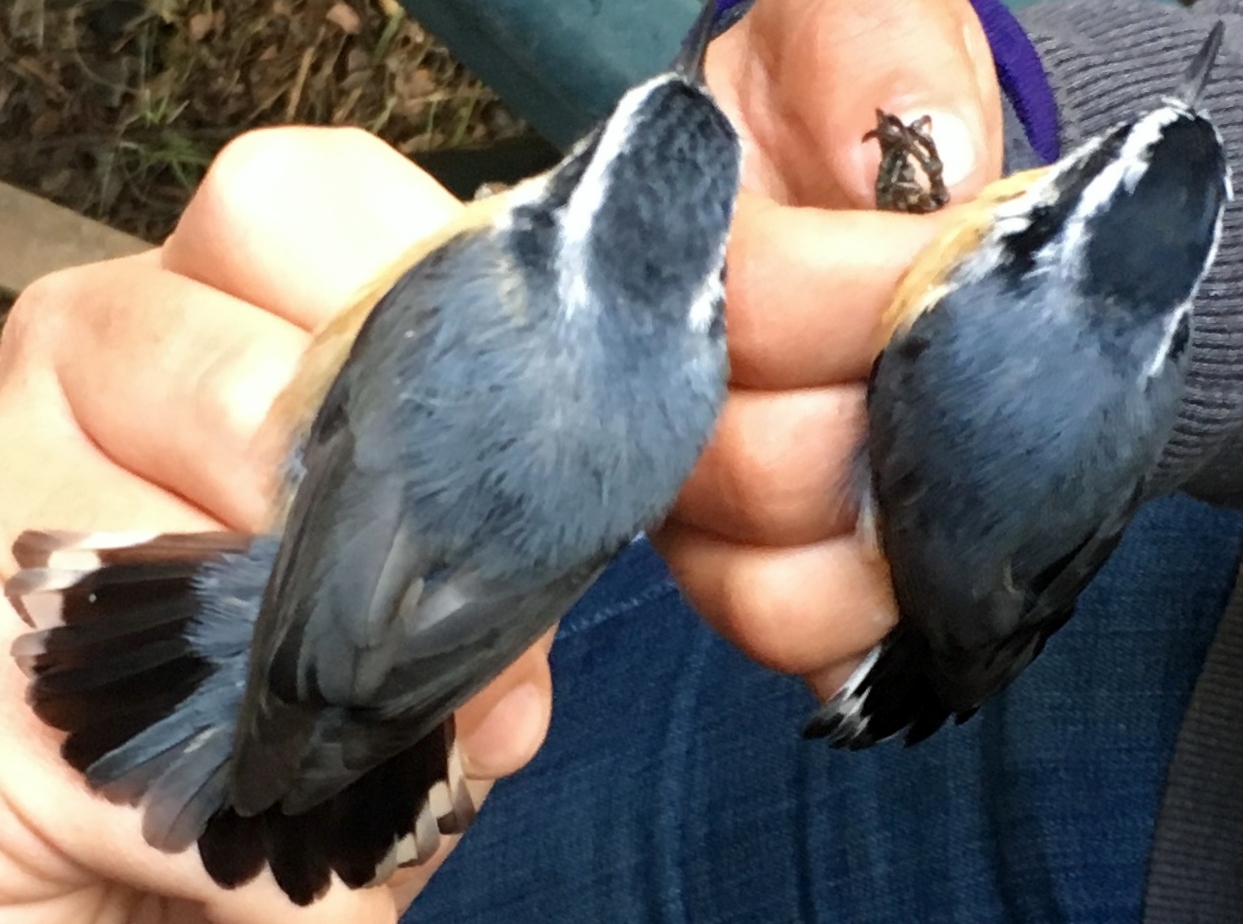
Red-breasted Nuthatch

Sitta canadenis

Appearance:
Small bird
Gray-blue upperparts
Orange underparts
White face and throat
Black crown and eye stripe
Long, pointed bill
Short tail and wings

Listen to its call.

It was Grand Central Station in our backyard today. At one time, there were four deer, two rabbits, a couple of squirrels and umpteen birds. Three flickers were taking turns at our log feeder, sharing it with a Downy Woodpecker and numerous chickadees and juncos. I felt a bit like Snow White minus the dwarves. (Maybe I should look at getting some garden gnomes). At a lull in the activity, this bird managed to get a quick snack. The others hadn't left him much but I think he managed to find something to his liking.

Learn more about the Red-breasted Nuthatch.

Additional photos:
female (left) / male (right)
 

Friday, January 28, 2011

Bushtit

Psaltriparus minimus

Appearance:
Tiny, plain bird
Gray-brown upperparts
Brownish crown
Paler underparts
Long tail
Small bill
Males:  dark eyes
Females: pale eyes

Listen to their song.


This swarm of birds descended upon our feeder earlier today. I say 'swarm' as it was much more bee-like than the usual flocks of birds we see. It reminded me a bit of the Hitchcock movie, although I can't see anyone being frightened of these little guys. They were so small they could almost fit inside the holes in the feeder. Very cute!

Learn more about the Bushtit.

Friday, January 21, 2011

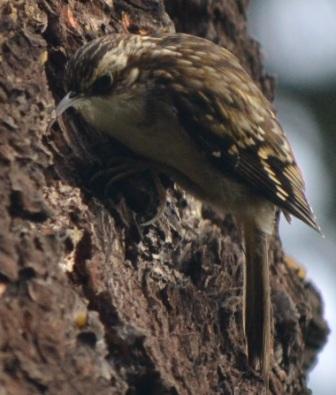
Brown Creeper

Certhia americana

Appearance:
Small tree climber
Brown upperparts with light spotting
White underparts
Long, thin bill with downward curve
Long tail

Listen to its song.


I spotted this bird creeping along the trunk of a large pine tree. It was a bit difficult to see as its coloring blended with the bark. The bird would start at the base of the tree and, using its long tail and sharp little claws, would quickly ascend up the trunk. Once it reached the top, it would literally drop down to the bottom to start over again. Quite a feat since the tree was about 200 feet high.

Learn more about the Brown Creeper.

Wednesday, January 19, 2011

Ruby-crowned Kinglet

Regulus calendula

Appearance:
Tiny bird
Short tail
Greenish-gray upperparts
Pale yellow underparts
White wing-bar, with black bar behind it
Diffuse, bold white eye-ring
Male's ruby crown seen only during courtship and aggression

Listen to its call.


I photographed this Ruby-crowned Kinglet as it flitted back and forth to a suet feeder outside the Nature House at Swan Lake.  This has got to be the cutest bird I've ever seen. It was only about ten centimeters long with a round little body and a fluffy yellow tummy. I just wanted to cuddle it.

 
Learn more about the Ruby-crowned Kinglet.

Monday, January 3, 2011

Chestnut-backed Chickadee

Poecile rufescens

Appearance:
Dark brown cap and throat
Red-brown back and sides
White cheeks and breast


                                                        Listen to its call.


This bird was among many of its kind frequenting the neighbour's feeder today. Although there was a mixture of seed in the dispenser, these birds seem to prefer sunflower seeds. They are also particularly fond of this simple hanging seed dispenser, possible due to its proximity to our hazel tree where they tend to 'escape' to between nibbles. 

Learn more about the Chestnut-backed Chickadee.