There are a number of reasons why I decided to take on this project. My first reason has to do with my interest in birds. This began shortly after moving to Victoria ten and a half years ago. With our house backing onto a wooded area, the chirping of birds is a familiar sound all year long. I often glance out the window to see birds of all forms in the yard throughout the day. Frequently I will pull out the Birds of Victoria or Birds of North America reference guides we have on hand. Unfortunately, the drawings in the first aren’t overly helpful for identification and the number of entries in the second is overwhelming. My second reason has to do with a photography course I took a number of years ago. Since that time I have been trying to think of a practical reason to buy a new camera. Taking pictures of birds requires a powerful zoom lens which my previous point-and-shoot camera could not accommodate. Perfect! My final reason was my desire to take on a new project to welcome in 2011. Hence, bird of the day was born.


Showing posts with label other swimming birds. Show all posts

Wednesday, January 13, 2021

Ancient Murrelet

Synthliboramphus antiquus


Appearance:
Small auk
Black face and crown
Grey back
White underparts
Pale, stubby bill
White throat extending back and up to ears
Breeding plumage:
   Black throat
   White band at neck
   White eyebrow

Listen to its call.

I stopped off at Ogden Point yesterday for a chilly walk along the breakwater. There were a number of seabirds around including Common Murre, Pigeon Guillemot and a couple of these little fellows: another lifer for me and a rarity for this area.

And now a bit of trivia for you. The name Ancient resulted from the grey back resembled a shawl draped across an old person's shoulders

Learn more about the Ancient Murrelet.

Tuesday, August 1, 2017

Cassin's Auklet

Ptychoramphus aleuticus

Appearance
Small seabird
Dark gray above and pale below
Small white crescent above eye
Dark bill with pale base to lower mandible
Blue feet

Listen to it's call.

A boat trip on the Juan de Fuca Strait off East Sooke Park this afternoon awarded us with a nice, close look at this auklet. There was quite a bit of excitement on board at the sighting as the Cassin's Auklet is on the near threatened list. 

Learn more about the Cassin's Auklet.

Thursday, December 29, 2016

Brandt's Cormorant

Phalacrocorax penicillatus 


Appearance:
Large cormorant
Long black body
Long, slender neck
Short black legs
Dark bill with blunt or hooked tip
Pale patch at base of bill
Breeding:
     Blue throat patch
     White plumes on sides of head, neck and back
     Turquoise eyes
Immature: (photographed)
     Brownish-black upperparts
     Tan on underparts
     Pale "V" at the border of breast and neck

Listen to its call.

There are three species of cormorant commonly seen along the coast in Victoria: Double-crested, Brandt's and Pelagic. I frequently have difficulty identifying the two larger species at a distance. At this year's Christmas Bird Count, one of the more experienced birders gave me a pointer which I'm happy to pass along. Although the Brandt's Cormorant is approximately the same length as the Double-crested Cormorant, the latter holds its neck slightly crooked whereas the Brandt's Cormorant's neck is almost always fully extended in flight. 


Learn more about the Brandt's Cormorant.

Sunday, December 11, 2016

Red-throated Loon

Gavia stellata

Appearance:
Small, slender loon
Thin bill, tilted upward slightly
Red eyes
White underparts
Breeding plumage: 
     Black bill
     Triangular red throat-patch    
     Dark grey-brown back, head and neck
     Narrow black and white stripes on the back of the neck
Non-breeding plumage: (photographed)
     Pale grey bill
     Pale grey-brown back, speckled with white
     White throat and face, extending above the eyes
     Dark grey head cap and neck
Juveniles:
     Pale grey bill 
     Brownish-grey plumage, with no pattern on back
     Pale neck

Listen to its call.

The lone call of a loon is haunting: similar to a wolf howling but more delicate somehow. This sorrowful sound is not, however, a sign of unhappiness at being alone. It is actually used to contact or attract the attention of a mate. 

Learn more about the Red-throated Loon.

Monday, January 11, 2016

Marbled Murrelet

Brachyramphus marmoratus

Appearance:
Small, chunky auk
Short, pointed, black bill
Short tail
Winter plumage:
   Black upperparts
   White underparts, throat, chin and collar
   White stripe over wings
Breeding plumage:
    Dark mottled brown all over

Listen to its call.

I saw a pair of these murrelets yesterday off the breakwater at Ogden Point.  They only stopped by for a minute before diving underwater, presumably in search of food.


Learn more about the Marbled Murrelet.


Sunday, November 8, 2015

Pied-billed Grebe

Podilymbus podiceps


Appearance:
Small, compact diving bird
Short, thick bill
Short neck
Brown plumage
Black throat in summer
Rusty tinge in winter
Breeding:
     White bill with black ring (pied)

Listen to its call.

Early last week, before the rain set in, I went for a walk around Swan Lake.  This little fellow was enjoying the sunshine and he was only too happy to pose for some photos.


Learn more about Pied-billed Grebe.

Sunday, November 23, 2014

Eared Grebe

Podiceps nigricollis


Description:
Small waterbird
Slightly upturned, black bill
Red eyes
Peak over the eye
Summer plumage
- black neck
- buffy-gold "ears" on side of dark head
Winter plumage (shown in photo)
- dull and dingy
- gray neck
- whitish ear patches near back of head
- "fluffy" rump/tail area

Listen to its call.

This little fellow was swimming in the ocean with a group of Western and Clark's Grebe. Although the Eared Grebe breeds in shallow lakes and ponds, in winter they prefers salt water.

Learn more about the Eared Grebe

Thursday, October 11, 2012

Clark's Grebe

Aechmophorus clarkii

Appearance:
Medium-sized waterbird
Long neck
Dark gray upperparts
White underparts, lower face and throat
Black back of neck
Black cap extends above eye
Red eye
Long, thin, bright yellow to orange-yellow bill

Listen to its call.

This bird was swimming with yesterday's bird of the day, the Western Grebe. Apparently, these birds are often found together and even nest side by side.  They were once considered a single species with different colour morphs, until it was discovered that they do not interbreed.

Western Grebe (back) / Clark's Grebe (front)
Learn more about the Clark's Grebe.

Wednesday, October 10, 2012

Western Grebe

Aechmophorus occidentalis


Appearance:
Medium-sized waterbird
Long neck
Dark gray upperparts
White underparts, lower face and throat
Black back of neck
Black cap extends below eye
Red eye
Long, thin, dull olive-yellow bill
White stripes on wing, visible in flight.

Listen to its call.

I photographed this bird at the marina near Kelowna's Water Park this past weekend. Nevertheless, as these grebes winter off the BC coast and harbours around Victoria from October to April, I think I am justified in including it here.

Learn more about the Western Grebe.

Friday, September 30, 2011

Horned Grebe

Podiceps auritus

Appearance:
Small grebe
Red eyes
Small black bill, often with pale tip
Summer: (not photographed)
Black head
Buffy-gold tufts along sides of  face
Reddish neck and flanks
Dark back
White belly
Winter:
Black cap, hindneck, and back
White cheeks, foreneck, flanks, and belly

Listen to its call.

To anyone who read the above description and thought, "but what the heck is a grebe?", you are not alone.  When I initially read this definition on a number of websites, I was perplexed. I didn't know what a grebe was in the first place so ...  Yet, it is surprising how often people will define a word using the same term.  Very annoying!  Anyway, for those of you, like me, who don't already know, a grebe is a diving waterbird with a long neck, lobed toes and almost no tail. It is a small, compact-bodied, almost completely aquatic bird that builds floating nests.  Who knew?


Learn more about the Horned Grebe.

Tuesday, August 30, 2011

Common Murre

Uria aalge

Appearance:
Medium-sized seabird
Charcoal black upperparts
White underparts
Long, straight, black bill
Breeding:
Dark head and neck
Non-breeding: 
White lower face and nape
Dark line curving down behind eye

Listen to its call.

Leaving Sidney Spit last Saturday after my discovery of two new birds, I received an added bonus on the ferry trip home when we passed a flock of these birds.


These large auks are mainly found in open marine waters and gather in large flocks far offshore; they only stay on land to breed.  Hmm...It's a good thing I took a little trip on the water then.

non-breeding
Learn more about the Common Murre.

Friday, July 29, 2011

Common Loon

Gavia immer


Appearance:
Large loon
Thick bill
Steep forehead
White underparts

Breeding:
  • Black bill
  • Black head
  • White collar
  • White breast
  • Dark back checkered white


Non-breeding / Juveniles:
  • Pale bill with dark ridge on top
  • Brownish-gray head and back
  • White throat and breast
  • Pale around eye
  • Partially white collar
Listen to its call.


My husband and I spent this past week kayaking in the Broken Group Islands. This archipelago is located on the west side of Vancouver Island, between Ucluelet and Bamfield. In addition to some stunning scenery and awesome kayaking, I did manage to see a few birds including this adult loon and a group of what I can only assume were juveniles. They were chasing each other and splashing around in a most humorous manner. Watching them gave me new insight into the term 'loony' . 


Learn more about the Common Loon.

Additional photos:


Sunday, June 26, 2011

Pigeon Guillemot

Ceppus columba

Appearance:
Medium-sized alcid (auk)
Thin, black bill
Red mouth lining
Red legs and feet
Breeding:
   Black plumage
   White patch on wing
Non-breeding: (below)
   Mostly white with mottled back
   Dark eye line

Listen to its call.

Taking advantage of the nice weather, my husband and I launched our kayaks from Island View Beach this morning. As I haven't been having much luck finding new birds on the land recently, I was pleased to encounter a wide variety of birds on the water. Unfortunately, I didn't have my usual camera along (for obvious reasons) but I managed to get a few shots of this bird with my old Canon PowerShot. 

Learn more about the Pigeon Guillemot.

Additional pictures:
breeding plumage
non-breeding plumage

changing to non-breeding plumage

Saturday, April 9, 2011

Rhinoceros Auklet

Cerorhinca monocerata

Appearance:
Medium-sized seabird
Black upper parts
Dark gray underparts
White belly
Eyes have long white plumes above and below
Yellow-orange bill with whitish horn
Legs and feet are gray

Listen to its call.


After my shortage of bird sightings recently, I was very excited to see this trio off Ten Mile Point this morning. Unfortunately, they spent a very short time close to shore, preferring to be further out at sea. I guess that's why they are called seabirds.

These birds, which also go by the name Unicorn Puffin, have a bill that sheds its sheath every year. The horn-like projection on the bill that gives these birds their unique appearance only develops when they are ready to breed.

Learn more about the Rhinoceros Auklet.

Saturday, March 19, 2011

Pelagic Cormorant

Phalacrocorax pelagicus

Appearance:
Small cormorant
Small head
Thin bill
Adult:
   Glossy black body
   Patches of white on flanks (breeding plumage)
   Dark red on face is hard to see
Immature:
   Very plain dark brown

Listen to its call.


Whenever I visit Cattle Point, one of these birds always seems to be roosting on top of the large navigational marker in the channel. They appear to be solitary birds, unlike the majority of the others around the area who can be quite gregarious. Sometimes I have seen them in a small group though, perched on the bottom of the marker. 


 Learn more about the Pelagic Cormorant.

Thursday, February 10, 2011

American Coot

Fulica americana
Appearance:
Water bird
Black body and head
White stripe on undertail
Thick white bill with dark band at tip
Red eyes
Yellow legs
Large feet with lobed toes

Listen to its call.

If it looks like a duck, swims like a duck and quacks like a duck, then it's probably a duck. That's how the saying goes, right? Well, it certainly isn't true in this case. Despite the fact that it was swimming with the ducks at Rithet's Bog, this bird is actually a member of the rail family. I'm pretty sure if I'd seen its large, un-webbed feet, I would have figured it out it on my own. 

Learn more about the American Coot.


Monday, January 10, 2011

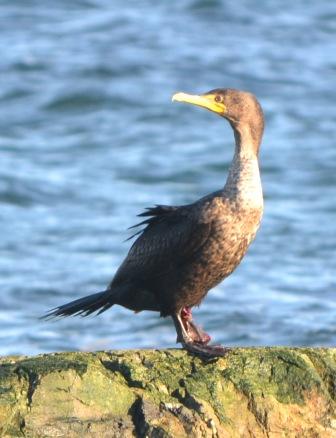
Double-crested Cormorant

Phalacrocorax auritus

Appearance:
Large - stocky body and long neck
Hook at tip of bill
Orange throat pouch
Immature: (photo to left)
    - Grayish-brown
    - Pale on throat and chest
Adult: (see additional photos)
    - Blackish all over
    - Orange bare skin on face and throat,
      extending up to lores


Listen to its call.


I photographed this bird on a rock just off Cattle Point last week. It was enjoying its solitude during one of our rare sunny periods.  After drying  its feathers in the breeze, it took off with a heavy wing-beat, flying low over the water.   

I read somewhere that cormorants have ancestors reaching all the way back to the time of the dinosaurs, which is certainly believable given their rather prehistoric appearance. This is definitely the oddest looking bird I've encountered thus far.

Learn more about the Double-crested Cormorant.

Additional photos: