There are a number of reasons why I decided to take on this project. My first reason has to do with my interest in birds. This began shortly after moving to Victoria ten and a half years ago. With our house backing onto a wooded area, the chirping of birds is a familiar sound all year long. I often glance out the window to see birds of all forms in the yard throughout the day. Frequently I will pull out the Birds of Victoria or Birds of North America reference guides we have on hand. Unfortunately, the drawings in the first aren’t overly helpful for identification and the number of entries in the second is overwhelming. My second reason has to do with a photography course I took a number of years ago. Since that time I have been trying to think of a practical reason to buy a new camera. Taking pictures of birds requires a powerful zoom lens which my previous point-and-shoot camera could not accommodate. Perfect! My final reason was my desire to take on a new project to welcome in 2011. Hence, bird of the day was born.


Showing posts with label medium-sized land bird. Show all posts

Tuesday, March 22, 2016

Red-breasted Sapsucker

Sphyrapicus ruber

Appearance:
Medium-sized woodpecker
Red head and breast
Yellowish-white belly
Black upperparts with white barring
White stripe on sides
Two rows of whitish bars on back
Juvenile:
   Brown head
   Extensive brown mottled on underparts

Listen to its call.

I went for a walk through Royal Roads Forest today and it was glorious. The weather was perfect, the company was delightful and I added another bird to my list of sightings. I have to credit my husband with catching sight of this woodpecker near the top of a rather tall snag.

Learn more about the Red-breasted Sapsucker

Wednesday, January 6, 2016

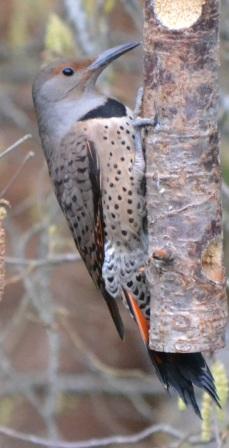
Northern Flicker - yellow-shafted

 Colaptes auratus auratus

Appearance:
Large woodpecker
Brown back with narrow black bars
Black chest patch
Black spots on belly
White rump
Yellow under wings and tail
Grey head
Brown face and throat
Red crescent on nape of neck
Black moustache (male)

Listen to its call.

Yellow-shafted Flickers reside in eastern North American while the Red-shafted ones reside in the west. So, you can imagine my surprise to see one with a yellow tail at my backyard feeder this morning.  In the picture below, you can just see the red crescent on the nape of her neck. Note the absence of a moustache.


Learn more about the Northern Flicker.

Friday, June 10, 2011

Hairy Woodpecker

Picoides villosus

Appearance:
Medium-sized woodpecker
Long chisel-like bill
White and black striped face
White underparts
Black upperparts with white bars on wings
White stripe down center of back
White outer tail features
Male - Red patch on back of head broken by a vertical black line connecting the crown and nape

Listen to its call.

I've been having a heck of a time finding one of these birds. I've often wondered if I had seen one on occasion only to mistake it for a Downy Woodpecker, as the two species look so similar in pictures. However, having finally seen the real thing in my backyard, I was struck by how much larger this bird is than the Downy. The bill is also significantly longer.

Learn more about the Hairy Woodpecker. 

Monday, May 2, 2011

Eurasian Collared-Dove

Streptopelia decaocto

 
  • Appearance:
  • Greyish-tan to pinkish-grey body and head
  • Black half-collar on back of neck
  • Dark primaries
  • Long, squared tail; undersurface with black base and white tip / uppersurface gray with white outer tips  
Listen to its call.

 
I saw a pair of these birds perched side by side on a wire on Martindale Road this afternoon.  At the time, it didn't occur to me to get a photograph of them from the back as well as from the front. However, in spite of that as well as the poor lighting, I'm pretty sure that I've identified this bird correctly. Of course, it helps that sightings of a pair of Eurasian Collared-Dove have been reported in the Martindale area recently.  Okay, so I might not be a bird expert yet, but at least I'm honest. 

 
Learn more about the Eurasian Collared-Dove.

Tuesday, March 15, 2011

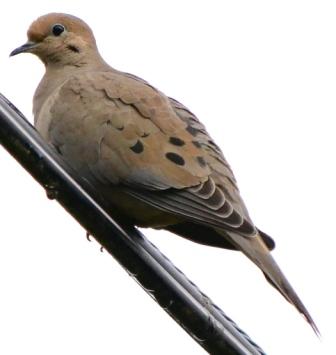
Mourning Dove

Zenaida macroura

Appearance:
Large, plump dove
Long, pointed tail
Small head
Gray-brown to buff-tan
Black spots on wings
Small, dark bill
Male:
   Pinkish chest
   Blue-gray crown

Listen to its song.


There had been numerous sightings of these birds on Dooley Road and Lochside Drive recently. After a number of misses, our visits to the area finally coincided.  I found these two birds perched on a telephone wire by the side of the road. 

All my life, I thought these birds were Morning Doves. Maybe they like to come out in the early part of the day. Apparently, it gets its name from its mournful song. Boy, do I feel silly. Stupid homonyms!

Learn more about the Mourning Dove.

Saturday, March 5, 2011

Belted Kingfisher

Ceryle alcyon

Appearance:
Large, crested head
Long, thick, black bill
Blue-gray head and back
White belly with blue breast band
Small white spot by each eye
White collar
Female (not photographed):
Rufous flanks
Rufous belly band

Listen to its call.

Driving along Dooley Road in Central Saanich, I spied this bird perched in a tree along the road. Unfortunately, as I got out of my car and approached it, it flew into a neighbouring yard. There was a large fence around the property and I leaned on the top of it to photograph the bird. After taking numerous shots, I readjusted my position to get a different angle. It was then that I noticed the sign "Caution. Electric fence". I was shockingly surprised. Actually, I wasn't, thankfully, but it was rather funny. I was so focused on getting my picture that I didn't feel a thing. 

Looking at this bird, it struck me that the crest looks a bit like a crown and I wondered if that was where it got its name. However, I didn't find any evidence of that. In fact, I couldn't find much about the etymology of the name at all. Even the Online Etymology Dictionary wasn't much help, stating that the name was first used in the "mid-15c and was originally king's fisher, for obscure reasons". Personally, I think my explanation is much better.

Learn more about the Belted Kingfisher.

Saturday, February 19, 2011

Pileated Woodpecker

Dryocopus pileatus
 
Appearance:
Very large woodpecker
Mostly black
Red crest
White stripe on neck
White under wings
Forehead and moustache 
    > red (male) / black (female)

Listen to its call.
male

female


When I awoke at 7:45 this morning, I was a little disappointed. I had wanted to join the Saturday morning bird walk but would never make it for the 8:00 start time. Instead, I lay in bed for a while longer before getting up to start my day. As I was brushing my teeth, I glanced out the bathroom window and saw this bird on a large pine tree just outside. I quickly grabbed my camera, which is always at the ready, and began to snap pictures. Soon it was joined by its mate and the two of them took turns chipping away at the bark of the tree between visits to our log feeder. As I watched, other birds began arriving at the feeders. Within twenty minutes, I had seen three woodpeckers (two Pileated and one Downy), three Spotted Towhees, one Bewick’s Wren, one Varied Thrush, a few sparrows of different varieties, three or four finches, the regular Chestnut-backed Chickadees and Oregon Juncos, and, of course, two squirrels and a rabbit. I know what you’re thinking but, no, I didn’t see a partridge out there (or a pear tree either for that matter). Anyway, who needs to get up early to hunt for birds when I’ve got such a parade right outside my window. You've got to love Victoria!

Learn more about the Pileated Woodpecker.

Monday, February 14, 2011

Rock Pigeon

Columba livia
 
Description:
Dark bill
Dark, iridescent head and neck
Pale gray body
Two black bars on wings
Dark tipped tail

(Variable in color)

Listen to its call

In honour of Valentine’s Day, I chose a dove as my bird of the day. Since doves mate for life, they represent love. This symbolism dates back to ancient times. In Greek mythology, the dove was the sacred creature of Aphrodite, the goddess of love. Okay, I know what you’re thinking, “That’s just a stupid pigeon”. Although commonly referred to as a pigeon, this bird is actually a dove. (At least it was until 2004 when it was officially renamed the Rock Pigeon). Furthermore, pigeons aren’t stupid at all. In fact, they are considered to be one of the most intelligent birds. Sort of makes you want to treat them with more respect, doesn’t it?

Learn more about the Rock Pigeon.

Tuesday, January 25, 2011

Northern Flicker - red-shafted

Colaptes auratus cafer


Appearance:
Large woodpecker
Brown back with narrow black bars
Black chest patch
Black spots on belly
White rump
Red under wings and tail
Gray face
Brown crown
Red 'moustache' stripe (male)

Listen to its call.

This fellow has been seen in our yard numerous times within recent weeks. He's usually perched on one of our large pine trees, although I've also seen him at our feeder on a couple of occasions. Northern flickers have long barbed tongues to lap up their prey. So, now I know who's been gobbling up the bark butter so quickly.

Learn more about the Northern Flicker.

Additional photos:

female -

Wednesday, January 12, 2011

Downy Woodpecker

Picoides pubescens

Appearance:
Small woodpecker
White and black striped face
Short bill
Red patch on back of head (male)
White under parts
Black upper parts with white bars on wings
White stripe down center of back

Listen to its call.

Looking for a bit of protection from the wind, I decided to avoid the water today and check out the woods behind our house instead. I didn't have far to go. This bird was foraging for food just outside our gate. He was climbing around the trees, moving up and down the trunks quickly, as well as on the smaller branches. One of the advantages of his size, no doubt.

And a bit of trivia .... The Downy’s name refers to the soft white feathers of the stripe on its back.

Learn more about the Downy Woodpecker.

female: