There are a number of reasons why I decided to take on this project. My first reason has to do with my interest in birds. This began shortly after moving to Victoria ten and a half years ago. With our house backing onto a wooded area, the chirping of birds is a familiar sound all year long. I often glance out the window to see birds of all forms in the yard throughout the day. Frequently I will pull out the Birds of Victoria or Birds of North America reference guides we have on hand. Unfortunately, the drawings in the first aren’t overly helpful for identification and the number of entries in the second is overwhelming. My second reason has to do with a photography course I took a number of years ago. Since that time I have been trying to think of a practical reason to buy a new camera. Taking pictures of birds requires a powerful zoom lens which my previous point-and-shoot camera could not accommodate. Perfect! My final reason was my desire to take on a new project to welcome in 2011. Hence, bird of the day was born.


Showing posts with label duck. Show all posts

Friday, November 20, 2020

Common Pochard

Aythya ferina 

Appearance:
Medium-sized diving duck
Triangular head shape 
Male:
   Long, dark bill with grey band
   Reddish-brown head and neck
   Black breast and tail
   Grey body
   Dark bill with pale grey saddle
   Red eyes
Female:
   Brown head and body
   Dark bill with narrow grey band

Listen to it’s call.

This duck, a native of Europe and Asia, must have flow off course a tad as it turned up on Summit Reservoir in Victoria. This is the first sighting of a Common Pochard in B.C. and it’s caused a fair bit of excitement in the birding community.

Learn more about the Common Pochard.  

Friday, December 1, 2017

Long-tailed Duck

Clangula hyemalis

Appearance:
Medium-sized diving duck 
Solid, black wings
White rump and belly 
Male:    
     Long, pointed, black tail
     Dark bill with pink band 
     Black breast
     White back, neck and head with grey cheek patch (winter)
     Dark back, neck and head with white patch around eye (summer)
Female:
     Short, pointed tail
     Grey bill
     Brown upperparts
     White face with dark crown and cheek patch (winter)
     Dark head with white around eye and at nape (summer) 

Listen to its call.

Looking out at the ocean from Glencoe Cove towards Haro Strait, large flocks of Long-tailed ducks are not unusual at this time of year. Unfortunately, they tend to stay quite a distance from shore making it difficult to photograph their distinctive plumage. This is the best I've managed so far... but I'll keep trying!

Learn more about the Long-tailed Duck.

Friday, November 10, 2017

Black Scoter

Melanitta americana

Appearance:
Large, bulky, sea-duck
Large bill
Male:
   All black
   Bulbous yellow knob on black bill
Female:
   Brownish-gray with pale cheeks
   Dark bill

Listen to its call

Learn more about the Black Scoter


Sunday, February 3, 2013

Redhead

Aythya americana

Appearance:
Medium-sized diving duck
Rounded head
Blue-gray bill with pale band near black tip
Male:
    Red head and neck
    Gray back
    Black breast and rear end
    Yellow eye
Female and juveniles
    Brown head and body 
    Darker bill than male

Listen to its call.

I spotted this male Redhead while walking around Elk Lake this week. It was swimming along with an assortment of other ducks. Initially, I thought it was a Canvasback but its bill was shorter and the color was wrong. Its head was also a different shape, much rounder than the elongated head of the Canvasback.

I read somewhere that the male Redhead's call is a cat-like meow and a deep purr.  Hmmm....that must be a bit frightening for the other ducks.

Learn more about the Redhead.

Wednesday, November 16, 2011

Blue-winged Teal

Anas discors
Appearance:
Small dabbling duck
Medium-sized, dark bill
Pale blue shoulder patch, visible in flight
Green speculum with white leading edge
Male (winter plumage):
    Blue-gray head with darker cap
    White crescent on face in front of eye
    Scaled buff and dark brown upperparts
    Buff breast and flanks with darker spotting
    White band at rear portion of flanks
    Black undertail coverts
Female / Male (summer plumage):
    Pale head
    Dark crown and eye line
    Pale eye ring and loral spot
    Mottled gray-brown body with darker back

Listen to its call.

I saw this duck at Summit Reservoir earlier this week surrounded by a large number of Wigeons, Mallards and Buffleheads. From what I've read, it is unusual to see one of these ducks at this time of year. Most of them are gone from the province by mid-October, having migrated to warmer climates.

Learn more about the Blue-winged Teal.

Monday, October 31, 2011

Cinnamon Teal

Anas cyanoptera

Appearance:
Small dabbling duck
Long, dark bill
Light blue wing-patch with white border
Male:
   Red-brown head and body
   Dark rump, tail and undertail
   Iridescent green on back of wing
   Red eye
Female: (not photographed)                          Listen to its call.
   Gray-brown overall
   Brown wing
   White at base of bill

While looking through photographs I'd taken earlier in the year, I realized that I hadn't posted the pictures I took of this bird back in May. Not surprisingly, I don't remember much about that day. I do know that I was at Panama Flats and, therefore, this duck must have been swimming in the flood plains. I discovered that these ducks, which are commonly found in shallow water, use their wide bills to filter food from the mud. Yummy!

Learn more about the Cinnamon Teal.

Sunday, October 30, 2011

Ruddy Duck

Oxyura jamaicensis
 
Appearance:
Small duck
Long tail, often held up
Dark wings
Large, flat bill

Male:
  Dark head
  White cheeks
   Breeding:                                        Non-breeding: (photographed)
      Blue bill                                         Gray-brown body
      Rusty brown body                         Dark bill                                         

Female:
  Gray-brown body
  Dark top of head
  Grayish white face
  Dark cheek stripe
  Dark bill

Listen to its call.

According to the rare bird alert transcript, there have been a number of sightings of these ducks around Victoria recently. Unfortunately, I haven't been able to find any around here. However, I did manage to  photograph this one in Walla Walla, Washington, a few days ago. I think it may have been the dark bill that was throwing me off. I was looking for a bright blue one.

Learn more about the Ruddy Duck.

Sunday, April 3, 2011

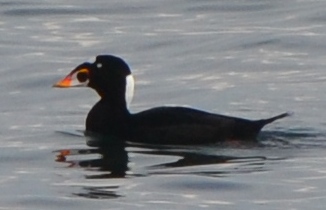
Surf Scoter

Melanitta perspicillata 
 

Appearance:
Medium-sized diving duck
Sloping forehead
Base of bill unfeather
White eyes
Orange legs and feet
Female: (above)
   Dark, sooty brown
   Two whitish patches on face
Male: 
   Mostly black
   White patches on forehead and nape
   White and orange bill with black base
Listen to its call.

This duck was swimming close to the public dock at Saanichton Bay this afternoon. There are two levels to the dock and, to get a closer shot, I went to the lower one. That probably wasn't the best decision as it turned out to be a floating dock. Have you ever tried to focus on an object in the water while the ground beneath your feet is moving up and down? It's a bit tricky.

Learn more about the Surf Scoter.

Additional photos:
 
adult male

young male

Wednesday, March 23, 2011

Gadwall

Anas strepera

Appearance:
Medium-sized dabbling duck
Finely barred gray body
Rust-brown shoulders
Black rump
White belly
Gray-brown head and neck
Gray bill
White patch in wing

Listen to its call.

I took this photograph at few weeks ago at Viaduct Flats. Unfortunately, although there were a fair number of these ducks in the pond, none of them seemed to favour the shore line. As the signage in the area asks visitors to stay on the designated trails and much of the area was flooded at the time of my visit, it wasn't possible for me to get close enough to take a decent photo. At least that's my story and I'm sticking to it!

Learn more about the Gadwall.

Additional photo:

Thursday, March 17, 2011

Hybrid Ducks

Ducks hybridise readily, both in captivity and in the wild. Sometimes wild ducks even crossbreed with escaped domestic ducks. Identifying hybrids is challenging because of the wide variations in colour and markings. Here are a few hybrid ducks I photographed in Beacon Hill Park. Each of them appears to be a cross between a Mallard and a different species. 


Saturday, March 12, 2011

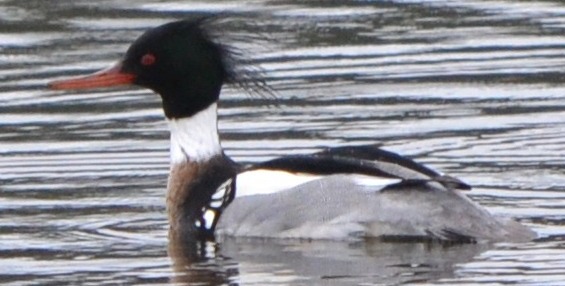
Red-breasted Merganser

Mergus serrator

Appearance:
Large diving duck
Slender and long bodied
Long, thin, orange bill
Red eyes
Shaggy crest at back of head

Male:
   Black and white back
   Gray sides
   Reddish-brown, mottled breast
   Green head
   White collar

Female:
   Gray body
   Reddish-brown head

Listen to its call.

These are more of the ducks I saw at Esquimalt Lagoon yesterday. The males, with their bright white collars and orange bills, were really quite striking.  The females, however, were even plainer than usual. What is it with these men always having to be the center of attention?


Learn more about the Red-breasted Merganser.

Friday, March 11, 2011

Greater Scaup

Aythya marilla  

male
Appearance:
Medium-sized diving duck
Rounded head; highest point
     towards front of head
Bluish-gray bill with black tip
Yellow eyes
Male:
  • Black head
  • Black neck and chest
  • White back with thin, black wavy lines
  • White sides and belly
  • Black rump and undertail
Female: 
  • Dark brown head and neck
  • White patch at base of bill                                      Listen to its call.
  • Dark brown back with white flecks    
  • Buff brown breast
  • Brown sides, flanks and tail                                     
  • Whitish belly  

females

After last weekend's birding success, I was a little discouraged with my lack of it during the week. The weather simply refused to cooperate with me. As soon as I stepped out the door with my camera, it would start raining. After numerous failures to locate any new birds in my usual haunts, I headed out to Esquimalt Lagoon yesterday. A fair number of these birds were hanging out among the swans, gulls and other ducks in that area.

I concluded they were Greater Scaup for a number of reasons. The heads of these ducks were rounded compared to the peaked heads of the Lesser Scaup I saw last month. The bills looked larger, as did the ducks themselves. The sides of the males looked whiter than those of the Lesser variety. And finally, at this time of year in our area, Greater Scaup are usually found in salt water and Lesser are more often found in fresh.

Learn more about the Greater Scaup.

Monday, March 7, 2011

Northern Shoveler

Anas clypeata

Description:
Small dabbler duck
Large, spatulate bill

   
Male:               
    Green head
    White chest
    Rusty sides
    Black bill


Female:
     Mottled brown
     Gray and orange bill

Listen to its call.


These ducks, which are supposedly fairly common at King's Pond, were being a tad elusive for me. Despite returning day after day, I always seemed to miss them. So, at the advice of the rare bird alert transcript, I headed to Summit Park on the weekend where I found the reservoir full of them. For those of you who are getting sick of all of my duck posts (you know who you are), you have to admit that these ones are pretty funny looking. The elongated spoon-shaped bill, which gives them such an odd appearance, has comb-like projections along its edges to filter out food from the water. 


Learn more about the Northern Shoveler.

Thursday, March 3, 2011

Canvasback

Aythya valisineria

Appearance:

female (left) /male (right)
Large diving duck
"Ski-jump" profile
Male:
    Chestnut head
    Black bill
    Black chest
    Whitish back
     Black rump
     Red eyes
Female:
    Pale tan head and neck
    Dark bill  
    Grayish body

Listen to its call.

Recently, I joined my husband on his run around Elk Lake. Oh sorry .... that sounds a bit misleading. To be more exact, I went with my husband to Elk Lake where I took pictures of ducks while he ran around the lake. I do have my priorities, you know. Unfortunately, this pair of ducks never came close enough to the shore for me to get a better picture than this one. At least it gives you a sense of their colouring and unique profile. Unfortunately, though, it doesn't show the wave-like pattern on the male's back and sides, which supposedly resembles canvas fabric (hence the name).

Learn more about the Canvasback.

Sunday, February 27, 2011

Northern Pintail

Anas acuta

Appearance:
Medium-sized dabbling duck
Long, thin neck
Pointed tail
Bronze-green speculum with black band
Male:
     Brown head
     White neck and underparts
     White stripe up neck
     Gray sides and back
     Long, black tail
     Black rear end bordered by yellowish-tan
     Black bill with bluish-gray stripes
     Gray legs
Female:
     Mottled buff-brown
     White belly
     Gray bill
     Bluish-gray legs

Listen to its call.


    Esquimalt Lagoon was teeming with these ducks yesterday. The number of males appeared to significantly outweigh the females, or maybe they were just more conspicuous. As usual, the males were far more striking than the females who looked much like all the other females around them. Ever wondered why this is? The females are plainer to aid with camouflage when roosting or feeding the young. I guess that makes sense but it would be nice to see a few more distinguishing characteristics. It would make identification so much easier.

    Learn more about the Northern Pintail.

    Saturday, February 26, 2011

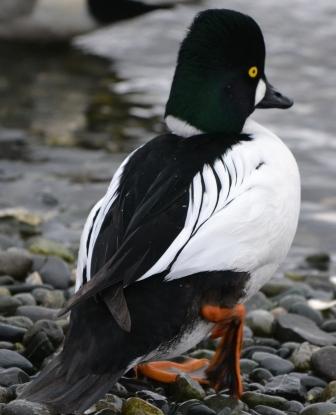
    Common Goldeneye

    Bucephala clangula

    Appearance:
    Medium-sized diving duck
    White flanks, breast and belly
    White patches on secondaries
    Yellow eyes
    Male:
    • Black head, back, wings and tail
    • Round white patch on face below eye
    • White scapulars with black striping
    • Black bill
    Female:
    • Chocolate brown head
    • Gray back, wings and tail
    • Yellow tip on black bill 

    Listen to its call.

    Continuing with my quest to learn more about ducks, I braved the frigid wind at Esquimalt Lagoon this morning. The area, which is a migratory bird sanctuary, was chockablock with ducks, geese, swans, gulls and herons. Had the weather been more favorable, I would happily have spent the day there. As it was, I only managed about twenty minutes before retreating to the warmth of the car. A small number of these ducks were scattered here and there. When I first saw the immature male (below), I thought it was a female with a bit of white froth from the ocean at the base of its bill. I realized my error when I noticed that the white patch was on both sides of its face. Once I finally located a female, the bill was a dead give-away that my earlier assumption had been incorrect. 
    
    young male
    
    Learn more about the Common Goldeneye.

    Additional photos:

    Friday, February 25, 2011

    Green-winged Teal

    Anas crecca

    Appearance:
    Very small dabbling duck
    White-edged green patch in wings
    Whitish belly
    Male:
        Chestnut head
        Green ear patch
        Dark bill
        Gray flanks and back
        Buff chest with dark spotting
        White stripe on side of chest
        Buff outer undertail coverts
        Black central undertail coverts
    Female: (below)  
        Mottled, light brown plumage
        White breast spotted with brown
        Strong eyeline
        Gray bill

    Listen to its call.

    Recently, I've become aware that my duck knowledge was sadly lacking. Although Mallards far outweight the others (both in number and size), I am amazed at the variety of ducks I've seen in the local ponds lately. They differ significantly in size, as well as colour. This one is positively tiny. I felt sorry for him, jostling for a position to receive a hand-out today. The larger ducks bullied him terribly, pushing him, chasing him and even nipping at his tail feathers. No wonder they usually stay out in the middle of the pond when I see them at Rithet's Bog, probably to avoid being intimidated by their oversized tormentors. 

    Size difference: 
    Green-winged Teal (front) /Mallard (back) 


    Learn more about the Green-winged Teal.

    Additional photos:
                    female
    

    Tuesday, February 22, 2011

    Eurasian Wigeon

    Anas penelope
     
    Appearance:
    Medium-sized duck
    Small blue-gray bill with black tip
    Male:
    • Rusty head
    • Buff crown stripe
    • Mostly gray body
    • White belly
    • Black rear end
    • White patch on wing    


    Female: 
    • Brown head
    • Mottled gray-brown or rusty-brown body
    • White patch on wing

    Listen to its call.

    These birds, originally from Siberia, were with a flock of their American cousins in Beacon Hill Park. While the males are distinct, the females of the two species looked quite similar. I'm not sure if this is a picture of a female Eurasian Wigeon or not but she seemed to be paired up with the male above. Also, the head of this female was browner than the heads of the other females around her, further evidence to suggest she was of a different species. And finally, she didn't seem to mind the snow this afternoon at all, leading me to conclude that she definitely wasn't from around here.

    Learn more about the Eurasian Wigeon.

    Wednesday, February 16, 2011

    Bufflehead

    Bucephala albeola

    Appearance:
    Small diving duck
    Small gray bill
    Male:
    • White 'scarf' around black head
    • Black back and neck
    • White breast, belly and flanks
    • Inner wing white / outer wing black
    Female:
    • Brown head and upperparts
    • Grayish-white underparts
    • White ear-spot and wing-patch

    Listen to its call.

    My bird watching today took me to King's Pond near Cedar Hill Golf Course. A large number of ducks of various types greeted me upon my arrival. They are obviously fed by visitors quite frequently. Every time a car pulled up, the ducks would rush over in expectation of a snack. A couple of times, I feared I would be flattened by stampeding waterfowl. In the end, I escaped unscathed except for a suspicious looking substance on my jeans (again).  Although the picture of the female was taken a few weeks ago near the Oak Bay Marina, I took the photo of the male today at the pond.

    Learn more about the Bufflehead.

    Saturday, February 12, 2011

    Lesser Scaup

    Aythya affinis
    
    
     Appearance:
    Medium-sized diving duck
    Dome-shaped head; peak at back of crown
    Bluish-gray bill with black tip
    Yellow eyes
    Male:
    • Black, effervescent head
    • Black neck and chest
    • White back with thin, black wavy lines
    • White flanks
    • Black rump 
    Female: 
    • Dark brown head
    • White patch at base of bill
    • Dark brown back with white flecks    
    • Brown chest, flanks and tail
    • Whitish belly  
    Listen to its call.

    As I set off in search of birds late this morning, the rain was just starting to come down. I was reminded of the old saying "lovely weather for ducks". Using this to my advantage, I headed to Beacon Hill Park where I knew I was sure to find lots of them. Thankfully, I wasn't disappointed. Within fifteen minutes, not only was I soaking wet but I had pictures of a number of new birds for my blog.

    Although Greater and Lesser Scaup are very much alike, the shape of the head as well as the fact that these ducks were swimming in fresh water convinced me that they were Lesser Scaup.

    Learn more about the Lesser Scaup.

     Incidentally, have you ever thought about all the idioms related to ducks? There seem to be a lot of them and not only to do with rain and water. I get the hunting ones but some of the others are pretty strange.  Lord love a duck! What does that even mean?