There are a number of reasons why I decided to take on this project. My first reason has to do with my interest in birds. This began shortly after moving to Victoria ten and a half years ago. With our house backing onto a wooded area, the chirping of birds is a familiar sound all year long. I often glance out the window to see birds of all forms in the yard throughout the day. Frequently I will pull out the Birds of Victoria or Birds of North America reference guides we have on hand. Unfortunately, the drawings in the first aren’t overly helpful for identification and the number of entries in the second is overwhelming. My second reason has to do with a photography course I took a number of years ago. Since that time I have been trying to think of a practical reason to buy a new camera. Taking pictures of birds requires a powerful zoom lens which my previous point-and-shoot camera could not accommodate. Perfect! My final reason was my desire to take on a new project to welcome in 2011. Hence, bird of the day was born.


Saturday, February 12, 2022

Mountain Bluebird

 Sialia currucoides

Appearance:
Small thrush
Round head
Thin, black bill
Male: 
- bright blue above
- paler blue on chest
- white belly
Female/immature: (photographed)
- mostly grey-brown
- tinges of pale blue on wings and tail
- belly colour varies from pale rufous to grey

Listen to its call.


Its always funny when you arrive at a spot where a rare bird has been seen and run in to every other birder in the area.  Frequently, we all stand around for what seems like hours and never catch a glimpse of our 'prey'. This morning, however, this one arrived right on cue. She and a male Western bluebird were foraging for insects, pouncing on their prey from power lines and fence posts. 

Learn more about the Mountain Bluebird. 

Saturday, May 8, 2021

Lazuli Bunting

Passerina amoena 

Appearance: 
Small, finch-like songbird 
Coned shaped bill
Gently sloping forehead 
Male (breeding): 
     Bright blue above 
     Pumpkin-colored breast 
     White belly and shoulder patch 
Juvenile / Male (non-breeding):
     Mottled blue and tan above 
     Pumpkin-coloured breast 
Female: 
     Grayish-brown above 
     Blue tinge to wings and tail 
     Two buffy wing bars 
     Pale cinnamon or tan breast

This gorgeous bird has been frequenting Beckwith Park for the last few days. And he’s certainly been attracting a lot of attention singing from exposed branches in his bright breeding plumage.  Unfortunately, as Lazuli Buntings are a rarity in the area, it was from birders and not females of his own species. 

Listen to it’s call. 

Sunday, January 17, 2021

Blue Jay

Cyanocitta cristata


Appearance
:
Large, crested songbird
Blue upper parts, with black and white markings
White underparts
Black necklace
Rounded tail

Listen to it’s call.

Growing up in Ontario, I was used to seeing Blue Jays year-round. However, this is the first time I’ve seen one in Victoria. Although scarce, there always seem to be a few reports every Winter.  Better photos to follow, hopefully. 

Learn more about the Blue Jay. 

Wednesday, January 13, 2021

Ancient Murrelet

Synthliboramphus antiquus


Appearance:
Small auk
Black face and crown
Grey back
White underparts
Pale, stubby bill
White throat extending back and up to ears
Breeding plumage:
   Black throat
   White band at neck
   White eyebrow

Listen to its call.

I stopped off at Ogden Point yesterday for a chilly walk along the breakwater. There were a number of seabirds around including Common Murre, Pigeon Guillemot and a couple of these little fellows: another lifer for me and a rarity for this area.

And now a bit of trivia for you. The name Ancient resulted from the grey back resembled a shawl draped across an old person's shoulders

Learn more about the Ancient Murrelet.

Sunday, January 3, 2021

Rusty Blackbird

 Euphagus carolinus

Appearance: 
Medium-sized blackbird
Pale yellow eye
Slender, slightly decurved bill
Male (breeding):
     Glossy black
 Male (non-breeding):
     Rusty feather edges 
     Bold eyebrow
Female :
    Grey-brown
    Rusty feather edges
    Bold eyebrow
    Darker feathers around eye

Listen to its call. 

With a new year upon us and COVID making it difficult to do much else, I've decide to ramp up my birding a bit.  Friday netted me a distant view of a Wilson's Snipe and a Black Phoebe in Central Saanich.  This afternoon, I made a trip to King's Pond in search of a Rusty Blackbird that has been hanging about lately  Happily, I located it in a large flock of Brewer's Blackbirds that flew in to partake of the bird seed liberally scattered on the ground by the many families enjoying the sunshine. 

Learn more about the Rusty Blackbird. 

Friday, November 20, 2020

Common Pochard

Aythya ferina 

Appearance:
Medium-sized diving duck
Triangular head shape 
Male:
   Long, dark bill with grey band
   Reddish-brown head and neck
   Black breast and tail
   Grey body
   Dark bill with pale grey saddle
   Red eyes
Female:
   Brown head and body
   Dark bill with narrow grey band

Listen to it’s call.

This duck, a native of Europe and Asia, must have flow off course a tad as it turned up on Summit Reservoir in Victoria. This is the first sighting of a Common Pochard in B.C. and it’s caused a fair bit of excitement in the birding community.

Learn more about the Common Pochard.  

Friday, August 16, 2019

Merlin

Falco columbarius

Appearance:
Small falcon
Adult male: slaty gray to dark gray
Females and immatures: browner
Broad, heavily streaked chest
Medium length tail with narrow white bands
Dark underwing
Sharply pointed wings

Listen to its call.

I witnessed this Merlin in pursuit of a Steller’s Jay earlier this week. Although the two birds were comparable in size, the Merlin relentlessly chased its prey, performing impressive turns and other aerial maneuvers. I'm happy to say that the two birds went their separate ways without any injuries sustained. 

Learn more about the Merlin. 


Thursday, April 4, 2019

Lapland Longspur

Calcarius lapponicus


Appearance:
Medium-sized sparrow-like bird
Short, thick, pointed, yellow bill 
Orange-brown face
Chestnut nape
White outer tail feathers
Rufous patch in wings
Streaked back and sides
Smudge on breast
Breeding male:
    Black head and throat
    Yellowish-white eyestripe
    Rufous nape
    White underparts
    Heavily streaked black-grey back

Listen to its call.

A rarity in the area, this bird was seen by several birders this morning foraging on the rocks near the Cattle Point boat launch.

Learn more about the Lapland Longspur.

Tuesday, September 18, 2018

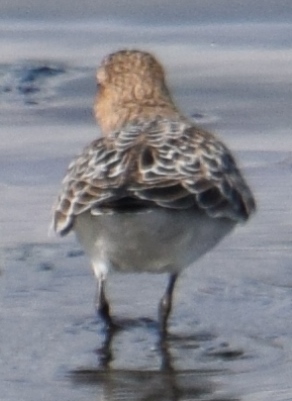
Baird's Sandpiper

Calidris bairdii

Appearance:
Small to medium shorebird
Black legs
Slightly drooping, black bill
Long wings extending beyond the tail
Dark brown, scaly upperparts
White underparts
Dark centre of rump and tail
Light brown head and breast, with dark streaking
Juvenile:
     Buff colored breast
     Scaly upperparts

 Learn more about the Baird's Sandpiper.


Saturday, September 8, 2018

Northern Mockingbird

Mimus polyglottos

Appearance:
Medium-sized songbird
Long tail
Grey-brown upperparts
Whitish-grey underparts
Two white wingbars
White patches on wing seen in flight
Black bill with slight downward curve
Yellow to greenish-yellow eyes


I would never have noticed this bird if it weren't for someone else drawing it to my attention.  It effectively blended into its surroundings, its drab plumage acting as camouflage.

Learn more about the Northern Mockingbird.

Friday, December 1, 2017

Long-tailed Duck

Clangula hyemalis

Appearance:
Medium-sized diving duck 
Solid, black wings
White rump and belly 
Male:    
     Long, pointed, black tail
     Dark bill with pink band 
     Black breast
     White back, neck and head with grey cheek patch (winter)
     Dark back, neck and head with white patch around eye (summer)
Female:
     Short, pointed tail
     Grey bill
     Brown upperparts
     White face with dark crown and cheek patch (winter)
     Dark head with white around eye and at nape (summer) 

Listen to its call.

Looking out at the ocean from Glencoe Cove towards Haro Strait, large flocks of Long-tailed ducks are not unusual at this time of year. Unfortunately, they tend to stay quite a distance from shore making it difficult to photograph their distinctive plumage. This is the best I've managed so far... but I'll keep trying!

Learn more about the Long-tailed Duck.

Friday, November 10, 2017

Black Scoter

Melanitta americana

Appearance:
Large, bulky, sea-duck
Large bill
Male:
   All black
   Bulbous yellow knob on black bill
Female:
   Brownish-gray with pale cheeks
   Dark bill

Listen to its call. 

Learn more about the Black Scoter. 


Tuesday, August 1, 2017

Cassin's Auklet

Ptychoramphus aleuticus

Appearance
Small seabird
Dark gray above and pale below
Small white crescent above eye
Dark bill with pale base to lower mandible
Blue feet

Listen to it's call.

A boat trip on the Juan de Fuca Strait off East Sooke Park this afternoon awarded us with a nice, close look at this auklet. There was quite a bit of excitement on board at the sighting as the Cassin's Auklet is on the near threatened list. 

Learn more about the Cassin's Auklet.

Thursday, July 27, 2017

Olive-sided Flycatcher

Contopus cooperi 

Appearance:
Bulky flycatcher
Short tail
Large head
Dark olive face, upperparts and flanks
Light underparts
Dark bill

Listen to its call. 

This flycatcher was perched at the top of a tall tree waiting to catch insects as they flew by.  Its distinctive "quick-three-beers" song made identification easy for a change.

Learn more about the Olive-sided Flycatcher. 

Tuesday, April 18, 2017

Townsend's Solitaire

Myadestes townsendi

Appearance:
Slim, medium-sized songbird
Short bill
Small, round head
Long tail
Grey overall
Prominent white eye-ring
White outer tail feathers
Buff wing patches 

Listen to its call.

We spotted this bird in the Garry oak meadow in Mount Tolmie Park this morning. Cleverly camouflaged, its plain grey plumage blended so well with the trees that it was difficult to keep in our sights. 

Learn more about the Townsend's Solitaire.

Sunday, April 9, 2017

Black Phoebe

Sayornis nigricans
Appearance:
Medium-sized flycatcher
Large head
Medium-long, squared tail
Slight peak at rear of crown
Straight, thin bill
Dark charcoal gray upperparts and chest
Darker black head
White belly
Pale grey edges on wing feathers

Listen to its call. 

A rarity for Victoria, one of these birds has been hanging around Maber Flats lately. Unfortunately, I needed a scope to see that bird making it impossible to take a decent photo. Luckily, I did have this one in my photo library taken a few years ago in San Diego. 

Learn more about the Black Phoebe.

Thursday, December 29, 2016

Brandt's Cormorant

Phalacrocorax penicillatus 


Appearance:
Large cormorant
Long black body
Long, slender neck
Short black legs
Dark bill with blunt or hooked tip
Pale patch at base of bill
Breeding:
     Blue throat patch
     White plumes on sides of head, neck and back
     Turquoise eyes
Immature: (photographed)
     Brownish-black upperparts
     Tan on underparts
     Pale "V" at the border of breast and neck

Listen to its call.

There are three species of cormorant commonly seen along the coast in Victoria: Double-crested, Brandt's and Pelagic. I frequently have difficulty identifying the two larger species at a distance. At this year's Christmas Bird Count, one of the more experienced birders gave me a pointer which I'm happy to pass along. Although the Brandt's Cormorant is approximately the same length as the Double-crested Cormorant, the latter holds its neck slightly crooked whereas the Brandt's Cormorant's neck is almost always fully extended in flight. 


Learn more about the Brandt's Cormorant.

Sunday, December 11, 2016

Tropical Kingbird

Tyrannus melancholicus 


Appearance:
Large flycatcher
Heavy gray bill
Gray head
Darker eye mask
Grayish-green back
Brown wings and  tail
Pale throat
Bright yellow underparts

Listen to its call.

This photogenic bird was hanging out in Ten Mile Point last weekend. Although a rarity to the area, records of Tropical Kingbird sightings occur annually in southwestern BC.


Learn more about the Tropical Kingbird.

Red-throated Loon

Gavia stellata

Appearance:
Small, slender loon
Thin bill, tilted upward slightly
Red eyes
White underparts
Breeding plumage: 
     Black bill
     Triangular red throat-patch    
     Dark grey-brown back, head and neck
     Narrow black and white stripes on the back of the neck
Non-breeding plumage: (photographed)
     Pale grey bill
     Pale grey-brown back, speckled with white
     White throat and face, extending above the eyes
     Dark grey head cap and neck
Juveniles:
     Pale grey bill 
     Brownish-grey plumage, with no pattern on back
     Pale neck

Listen to its call.

The lone call of a loon is haunting: similar to a wolf howling but more delicate somehow. This sorrowful sound is not, however, a sign of unhappiness at being alone. It is actually used to contact or attract the attention of a mate. 

Learn more about the Red-throated Loon.

Monday, November 21, 2016

Red Phalarope

Phalaropus fulicarius


non-breeding
Appearance:
Smaller wader
Straight bill
Short legs
Lobed toes
Adults:
     Distinct white stripe down the wing
     Dark stripe down the tail
     Contrasting color on sides of rump
     Breeding plumage:    
         Rufous neck and underparts
         Dark brown and black above
         White cheek patches
         Yellow bill
         Black cap (female) / Brown cap (male)
     Non-breeding plumage: (photographed)
         Light grey above, unstreaked
         White below
         White head
         Black ear patch behind the eye
         Black bill with lighter base
Juveniles:
     Black backs edged in buff
     Buff underparts and head
     Dark patch through the eye  

Listen to its call. 
 
Although phalaropes are sandpipers, which are typically shorebirds, these birds spend most of the year out at sea. They are also one of the few birds where the female of the species is more colourful and larger than the male. This is because the females are polyandrous. They have to look good to attracted the attention of multiple males. In contrast, the males need to be duller to avoid detection of predators while providing most of the parental care.

Learn more about the Red Phalarope.