There are a number of reasons why I decided to take on this project. My first reason has to do with my interest in birds. This began shortly after moving to Victoria ten and a half years ago. With our house backing onto a wooded area, the chirping of birds is a familiar sound all year long. I often glance out the window to see birds of all forms in the yard throughout the day. Frequently I will pull out the Birds of Victoria or Birds of North America reference guides we have on hand. Unfortunately, the drawings in the first aren’t overly helpful for identification and the number of entries in the second is overwhelming. My second reason has to do with a photography course I took a number of years ago. Since that time I have been trying to think of a practical reason to buy a new camera. Taking pictures of birds requires a powerful zoom lens which my previous point-and-shoot camera could not accommodate. Perfect! My final reason was my desire to take on a new project to welcome in 2011. Hence, bird of the day was born.


Tuesday, August 23, 2011

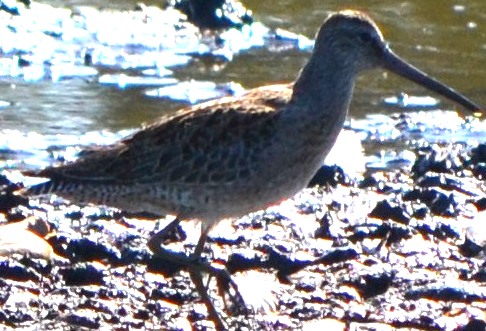
Short-billed Dowitcher

Limnodromus grieseus

Appearance:
  • Medium-sized shorebird
  • Long, straight bill
  • Long, greenish legs
  • Short neck
  • Dark crown and eyeline
  • White and black bars of equal width on tail feathers
  • Breeding plumage:
  •     Mottled brown upperparts
  •     Pale orange underparts
  •     Spotting on sides
  •     White belly
  • Overall grey in winter
Listen to its call.
White and black bars of equal width on tail feathers
By late summer, most of the water has dried up at Panama Flats. Only a few large puddles remain where shorebirds congregate ... when the gaggles of Canada Geese allow it. Seeing a number of different sized shorebirds towards the centre of the flats, I moved in for a closer look, attempting to make my way through the squishing mud without any creeping up my sandals. It was disgusting! The mucky, (and I'm sure) excrement-covered shoes are still sitting outside our front door, too foul to be allowed in the house. The things I do just to get a picture! 

Learn more about the Short-billed Dowitcher.

Thursday, August 18, 2011

Empidonax Flycatcher


Appearance:
Small bird
Olive-gray upperparts
Yellowish-white underparts
Two pale wing-bars
White eye-ring


There are between eleven and fifteen different species of Empidonax Flycatchers (depending on which book you read), five of which are found in Victoria. They all look very much alike; apparently they are best identified by their voice. Unfortunately, not being up on my Flycatcher knowledge, I wasn't paying much attention to this bird's song while chasing it around with my camera. So, to be on the safe side, I'm going to following the recommendation of Kenn Kaufman and just call it an Empid.

Learn more about Empidonax Flycatchers.

Sunday, August 14, 2011

Warbling Vireo

Vireo gilvus

Appearance:
Small songbird
Olive-gray upper parts
Yellowish-white lower parts
No wing-bars
Prominent, white eyebrow
Faint, dark eye-line

Listen to its song.

While walking along a logging road at the edge of a forested area, I first heard then saw this bird as it flitted about in the trees next to a small stream.  I had photographed one of these birds months ago at Blenkinsop Lake. Unfortunately, those pictures were poor as the bird was high up in a tree. So, although these ones were taken in the Shuswap where I've been on vacation for the last week (hence my lack of blog entries), I think this can legitimately be classified as a 'bird of Victoria'.

Here's a question for you. Why do the smallest birds always seem to be in the tops of trees?

Learn more about the Warbling Vireo.

Sunday, July 31, 2011

Wandering Tattler

Heteroscelus incanum

Appearance:
Medium-sized sandpiper
Short, thick, yellow legs
Solid gray upperparts
Finely streaked face
Dark eye line
White eye ring
Longish, straight, black bill
Breeding:
   Heavily barred underparts
Non-breeding:
   Gray breast
   White belly

Listen to its call.

After enjoying a cup of tea at the Ogden Point Cafe this afternoon, I went for a short stroll along the breakwater. Being a long weekend, the area was bustling with activity: people on the walkway, divers in the water and shorebirds at the water's edge. I was taking pictures of a group of Black Turnstones on the rocks below when my husband drew my attention to this bird.  It was bobbing along the ledge on the outside of the breakwater, moving surprisingly quickly. If it hadn't stopped at regular intervals to probe for food, I would have had to take up jogging just to keep up with it. Thankfully, I didn't have to go to those extremes to get these pictures.


Learn more about the Wandering Tattler.

Saturday, July 30, 2011

California Gull

Larus californicus


Appearance:
Medium-sized gull
Dark eye
Greenish-yellow legs
Yellow bill with black and red spot near tip
White head, underparts and tail
Slate-grey back
Black wingtips with white near tip

Listen to its call.

According to experts, the most important basic keys to identifying gulls are size, shape, and color pattern.  However, there are so many variations between adult and immature gulls, as well as breeding and non-breeding plumage, that I find this an almost impossible task. 

Unlike most of the gulls I've seen around Victoria, many of the ones in the Broken Group Islands had yellow legs. They also had both a red and black spot near the tip of their lower mandibles. As the California Gull is the only gull in southwestern British Columbia with both of these features, I had a relatively easy time with this identification ... thankfully. 

Difference in size between California Gull (left) and Ring-Billed Gull (right)
Learn more about the California Gull.

Friday, July 29, 2011

Common Loon

Gavia immer


Appearance:
Large loon
Thick bill
Steep forehead
White underparts

Breeding:
  • Black bill
  • Black head
  • White collar
  • White breast
  • Dark back checkered white


Non-breeding / Juveniles:
  • Pale bill with dark ridge on top
  • Brownish-gray head and back
  • White throat and breast
  • Pale around eye
  • Partially white collar
Listen to its call.


My husband and I spent this past week kayaking in the Broken Group Islands. This archipelago is located on the west side of Vancouver Island, between Ucluelet and Bamfield. In addition to some stunning scenery and awesome kayaking, I did manage to see a few birds including this adult loon and a group of what I can only assume were juveniles. They were chasing each other and splashing around in a most humorous manner. Watching them gave me new insight into the term 'loony' . 


Learn more about the Common Loon.

Additional photos:


Thursday, July 14, 2011

Yellow Warbler

Dendroica petechia

Appearance:
Small songbird
Bright yellow underparts
Yellow-green upperparts
Plain yellow face
Prominent, dark eye
Yellow eye-ring
Thin, pointed bill
Short-tail
Yellow tail spots
Male: (not photographed)
   Reddish-brown breast streaks
Female:
   Duller, no breast streaks
  
Listen to its call.


This is just one of the many birds I saw at Rithet's Bog last weekend. Although its yellow plumage is similar to many female and immature warblers, there are a number of features on this bird that I was able to use for identification. The large, dark eye and yellow in the tail feathers are characteristics unique to Yellow Warblers. However, I'm not sure whether it's a female or a young bird (or perhaps a young female). Although the slate-coloured bill in the photo above is typical of the adult Yellow Warbler, the pale bill in the photo below suggests a young bird.  This is an example of how the wrong light angle can result in problems with identification.

Learn more about the Yellow Warbler.