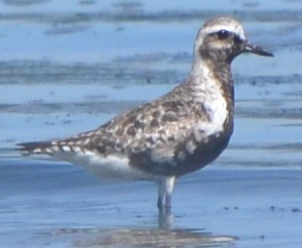
Pluvialis fulva
Appearance:
Medium-sized plover
Moderately long legs
Large head
Large, dark eyes
Golden and black speckled back
Breeding plumage:
Black from face to belly, bordered with white
Black speckling along the white border by the underparts and under tail
Non-breeding plumage:
Buff wash with dark speckling on the breast
Juvenile:
Light barring on chest and flanks
Yellowish head and breast
Listen to its call.
When I initially spotted this shorebird, I thought it was a Black-bellied Plover as they are fairly common around Victoria. It wasn't until I was reviewing my photos later that I realized my mistake. There are a number of differences between the two species, one of which I found a bit ironic. There is more black on the belly of the Pacific Golden-Plover then on the Black-bellied variety.
Learn more about the Pacific Golden-Plover.
There are a number of reasons why I decided to take on this project. My first reason has to do with my interest in birds. This began shortly after moving to Victoria ten and a half years ago. With our house backing onto a wooded area, the chirping of birds is a familiar sound all year long. I often glance out the window to see birds of all forms in the yard throughout the day. Frequently I will pull out the Birds of Victoria or Birds of North America reference guides we have on hand. Unfortunately, the drawings in the first aren’t overly helpful for identification and the number of entries in the second is overwhelming. My second reason has to do with a photography course I took a number of years ago. Since that time I have been trying to think of a practical reason to buy a new camera. Taking pictures of birds requires a powerful zoom lens which my previous point-and-shoot camera could not accommodate. Perfect! My final reason was my desire to take on a new project to welcome in 2011. Hence, bird of the day was born.
Showing posts with label plover. Show all posts
Saturday, May 21, 2016
Saturday, August 27, 2011
Semipalmated Plover
Charadrius semipalmatus
A number of flocks of these birds were around the beach, foraging for food on the tidal flats. All of the ones I saw had black bills, making me wonder if perhaps I'd made a mistake with their identity. Then I caught sight of their feet, which reassured me. Semipalmated is an adjective used to describe wading birds that have toes webbed for part of their length. Oddly enough, I only discovered this when I looked up the word in the dictionary. Why don't the bird books tell you these things?
- Small plover
- Grey-brown above
- White below
- Single, dark chest band
- Black breast band, sides of head, and forecrown in breeding adults; brown in non-breeding adults and juveniles.
- Yellowish-orange legs
- Short, dark bill with orange base (all black on juvenile)
Having no obligations for the day, I suggested to my husband that we take the ferry to Sidney Spit for a picnic. It was a lovely day for it; sunny, but not too hot, and lots of shorebirds to photograph. Perfect!
A number of flocks of these birds were around the beach, foraging for food on the tidal flats. All of the ones I saw had black bills, making me wonder if perhaps I'd made a mistake with their identity. Then I caught sight of their feet, which reassured me. Semipalmated is an adjective used to describe wading birds that have toes webbed for part of their length. Oddly enough, I only discovered this when I looked up the word in the dictionary. Why don't the bird books tell you these things? Monday, March 14, 2011
Black-bellied Plover
Pluvialis squatarola

Short, thick black bill
Short neck
Dark legs
Dark wing tips
Description:
Medium-sized shorebirdShort, thick black bill
Short neck
Dark legs
Dark wing tips
Winter adult:
Gray head
White underparts
Gray, mottled back
Breeding plumage:
Black from face to belly
Listen to its call.
I saw a group of these birds on the rocks at Clover Point yesterday afternoon. They were bigger than the Dunlin feeding close by. The tide was low and they were having quite a feast until three Black Oystercatchers came along and frightened them all away.
No wonder I had difficulty identifying this bird. There wasn't a black-belly to be seen. However, in breeding plumage (pictured below), it is black from the face to the belly.
Monday, January 31, 2011
Killdeer
Charadrius vociferus
Appearance:
Large plover
Large, round head
Short, dark bill
Large eye
Brownish-tan upper parts
White underparts
Two black bands on chest
White collar and forehead
Orange rump, visible in flight
Listen to its call.
I ventured back to the rocks by the marina today to see who was hanging about. Although the sun was out, the wind at the shore was bitter so I didn't last very long. I just managed to snap a few pictures of these birds before my hands turned completely numb.
Word history from the Merriam Webster Student Dictionary:
Killdeers are not vicious birds. They have no special hatred of deer, and they do not eat venison.
Whew ... I'm glad we got that cleared up.
Incidentally, both its common and Latin names come from its distinctive call, "kill-deear". Vociferus means shouting noisily.
Learn more about the Killdeer.
Appearance:
Large plover
Large, round head
Short, dark bill
Large eye
Brownish-tan upper parts
White underparts
Two black bands on chest
White collar and forehead
Orange rump, visible in flight
Listen to its call.
Word history from the Merriam Webster Student Dictionary:
Killdeers are not vicious birds. They have no special hatred of deer, and they do not eat venison.
Whew ... I'm glad we got that cleared up.
Learn more about the Killdeer.
Subscribe to:
Posts (Atom)