There are a number of reasons why I decided to take on this project. My first reason has to do with my interest in birds. This began shortly after moving to Victoria ten and a half years ago. With our house backing onto a wooded area, the chirping of birds is a familiar sound all year long. I often glance out the window to see birds of all forms in the yard throughout the day. Frequently I will pull out the Birds of Victoria or Birds of North America reference guides we have on hand. Unfortunately, the drawings in the first aren’t overly helpful for identification and the number of entries in the second is overwhelming. My second reason has to do with a photography course I took a number of years ago. Since that time I have been trying to think of a practical reason to buy a new camera. Taking pictures of birds requires a powerful zoom lens which my previous point-and-shoot camera could not accommodate. Perfect! My final reason was my desire to take on a new project to welcome in 2011. Hence, bird of the day was born.


Saturday, May 21, 2011

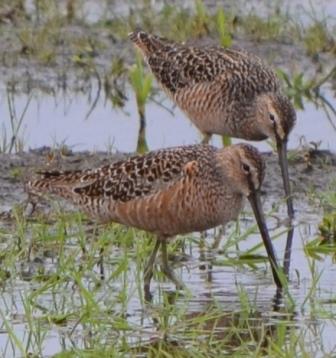
Long-billed Dowitcher

Limnodromus scolopaceus

 
Appearance:
  • Medium-sized shorebird
  • Long, straight bill
  • Long, greenish legs
  • Short neck
  • Dark crown and eyeline
  • Black bars on tail feathers wider than white
  • Breeding plumage:
  •      Mottled brown upperparts
  •      Rich chestnut underparts
  •      Barred sides
  • All gray in winter

Listen to its call.

 
What better way to spend a cloudy Saturday morning than probing in the mud with half a dozen friends? Okay, so that might not appeal to everyone but these birds seemed to be having a great time bobbing their heads up and down in the shallow waters of Panama Flats.

Learn more about the Long-billed Dowitcher.

Friday, May 20, 2011

Turkey Vulture

Cathartes aura
 
Appearance:
Very large bird
Small, unfeathered, red head
Hooked, ivory-colored bill
Brownish-black plumage
Long wings with gray flight feathers underneath
Long, rounded tail
Pink legs and feet

Listen to its call.

Leaving Island View beach this afternoon, I noticed two of these birds roosting in a dead tree by the side of the road. I was surprised at their rather comical appearance; the head is extremely small in relation to the body. After watching them for several minutes they took off over the fields. A little while later I caught sight of them soaring overhead without seeming to flap their wings at all.  They just seemed to float on the air currents. It was quite beautiful to watch. I have trouble relating these birds to the dirty, unscrupulous scavengers that their reputation affords them.


Learn more about the Turkey Vulture.

Wednesday, May 18, 2011

Blacked-headed Grosbeak

Pheucticus melanocephalus

Appearance:
Medium-sized, stocky songbird
Large, cone-shaped bill.

Male:
  • Deep orange breast, collar and underparts
  • Black head and upperparts
  • Black and white wings 
  • White undertail coverts
  • White spots in black tail
Female: (not photographed)
  • Black and white crown stripes
  • Buffy underparts with streaking at the sides
  • Dark gray upperparts
Listen to its call.

I heard this bird long before I saw it perched at the top of a tree near Blenkinsop Lake last evening. The weather was ideal for a stroll after dinner and the vocal performance given by this bird was enjoyed by many along the boardwalk.

Learn more about the Black-headed Grosbeak.

Additional pictures:
Juvenile

Sunday, May 15, 2011

Sanderling

Calidris alba

Appearance:
Small sandpiper
Medium-length, straight, dark bill
Dark legs
White wingstripe bordered in black
Breeding plumage: (no photo)
Rufous head and neck
Rufous wash extending onto back
Non-breeding plumage:
Pale gray head and upperparts
White underparts
Faint, partial gray breast band

Listen to its call. 

I saw this bird running along the tide line at Esquimalt Lagoon beach with a couple of Dunlins last week. The three of them would run up the beach to avoid the waves, then turn and run back down as the waves receded. They were probably just looking for food but they reminded me of playful children enjoying a day at the shore.

Sanderling (left) / Dunlin (right)
Being a student of linguistics, the origin of words always interests me. So, what about Sanderling?  Although I really have no idea of its origin, I have a theory. Sandpiper has been truncated in the middle and the suffix -ling, which is a diminutive modifier, has been added to the noun. So, in essence, its name means that it's a small sandpiper. Isn't linguistics fun?!

Learn more about the Sanderling.

Additional photos:

Saturday, May 14, 2011

Caspian Tern

Hydroprogne caspia (formerly Sterna caspia)

Appearance:
  • Large, gull-like tern
  • Large, thick, red-orange bill with dark tip
  • White head with black cap
  • White neck and belly
  • Pale gray upper wings and back
  • White, shallowly forked tail
  • Pale underwings with dark primary feathers
  • Black legs

Listen to its call.

Before today, my knowledge of terns consisted of crossword puzzle definitions like 'sea eagle' or 'gull-like seabird'.  However, I now know there are ten genera of terns, which were once considered a subfamily of the gull family. This bird, the only one in its genus, is the world's largest tern. I saw a number of them at Esquimalt Lagoon earlier this week. They are almost the size of a large gull, which is probably why I've never noticed them before, but they have a distinct way of flying that sets them apart from the gulls. 

This one was flying over the water with its bill pointing down, when it suddenly plunged in to catch a fish.

Learn more about the Caspian Tern.

Additional pictures:


Thursday, May 12, 2011

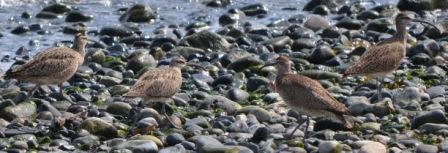
Whimbrel

Numenius phaeopus

Appearance:

  • Large shorebird
  • Long, decurved bill
  • Long, dark legs
  • Grayish-white and brown head stripes
  • Brown upperparts with small light and dark spots 
  • Brown streaked neck and breast
  • White belly and undertail coverts 

 Listen to its call.

On a visit to Esquimalt Lagoon this afternoon, I was pleasantly surprised to find a number of interesting birds on the beach to the south. This group of six were using their long, curved bills to probe in the sand, probably in search of invertebrates for dinner.


Learn more about the Whimbrel.

Tuesday, May 10, 2011

Western Sandpiper

Calidris mauri


Appearance:
  • Small sandpiper
  • Moderately long bill, thinner at tip than at base, with slight droop
  • Black legs
  • White underparts
  • Thin, white wing stripe
  • Black line on rump extends onto tail


Adult:
  • Indistinct white supercilium
  • Rufous scapulars, crown and cheek (breeding plumage)
  • Black back feathers and wing coverts with white edges
  • Much black streaking and spotting on breast
  • Black chevrons on flanks
Juvenile:
  • Indistinct gray crown and pale supercilium
  • Rufous scapulars
  • Black-based back feathers and wing coverts with white and gray edges
  • Faint, partial gray breast band
Listen to its call.

Western Sandpipers (back) / Least Sandpiper (front)
This bird is very similar in appearance to yesterday's bird of the day. However, when seen together, the Western Sandpiper is slightly larger than the Least Sandpiper. The longer bill and dark legs also set these birds apart.
 
Learn more about the Western Sandpiper.